
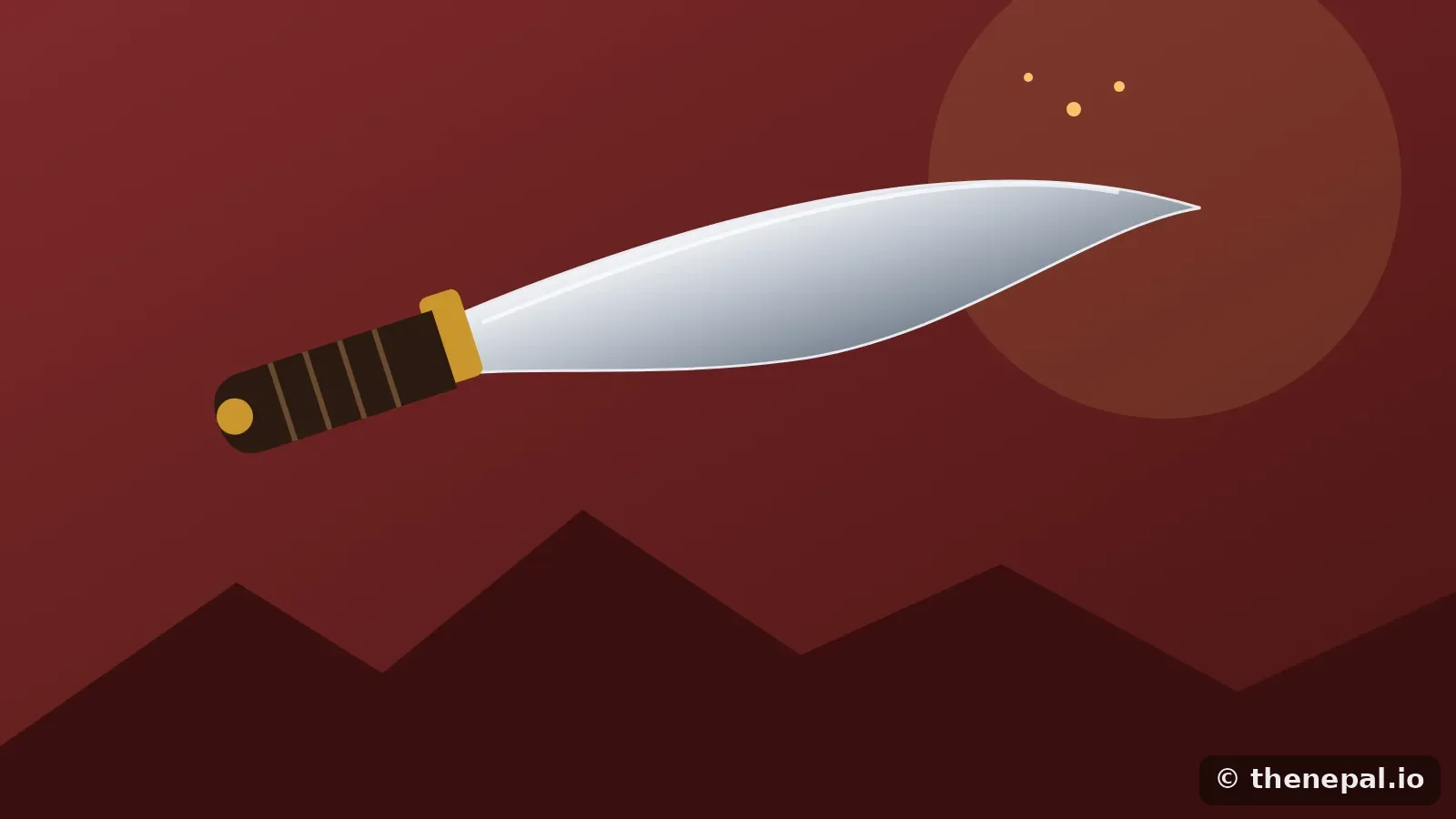
The khukuri (खुकुरी) is the curved knife of Nepal's hills and the blade most often called the country's national weapon. It is a farm tool, a household knife, a ceremonial object and the sidearm of the Gurkha soldier, all in one.
Is the Khukuri Officially the National Weapon?
Which national symbols are official? See the full list →
Source: Wikipedia, "Kukri" (the claim is cited to the Gurkha Brigade Association and is flagged there as needing a better source); Gurkha Brigade Association, "The Kukuri".
What a Khukuri Looks Like
The khukuri is a knife or short sword with a distinctive inward curve. It is forward-balanced and designed mainly for chopping, with a belly that widens toward the tip. A general-purpose khukuri is typically about 40–45 cm long and weighs roughly 450–900 g.
| Part | What it is |
|---|---|
| Blade | Often forged from spring steel; some modern blades are made from recycled truck suspension steel. |
| Notch (cho, kaudi or karda in different usage) | A small cut near the handle. Explanations include stopping blood or sap running onto the handle and marking the end of the sharpened edge. One tradition says it stands for the Hindu trinity of Brahma, Vishnu and Shiva. |
| Handle | Hardwood or water-buffalo horn, traditionally fastened with laha, a natural tree-sap adhesive. |
| Scabbard | Wood or metal, covered in leather or metal. |
| Two small tools | A blunt chakmak for sharpening or striking a spark with flint, and a small sharp karda used for skinning and small jobs. |
Eastern styles are named after towns in eastern Nepal, such as Chainpur, Bhojpur and Dhankuta, which are known for finely worked blades. Western styles are generally broader. Both are found across the country.
History
Kukri-type blades have a long history in the Indian subcontinent, and the earliest recorded use is dated to the 7th century, though much of the early story is uncertain. The oldest surviving examples cited are associated with Drabya Shah, around 1559.
The khukuri became widely known outside Nepal through the wars of unification and the Anglo-Nepalese War of 1814–1816. The Gurkha Brigade Association's history credits the Gorkha troops of Prithvi Narayan Shah, who took Kathmandu in September 1768, with carrying the knife.
Source: Wikipedia, "Kukri"; Gurkha Brigade Association, "The Kukuri".
More Than a Weapon
In the hills most households own a khukuri. It cuts firewood and fodder, clears brush, helps with cooking and butchery and is part of daily farm life. It also appears in Nepali heraldry (the former royal arms showed crossed khukuris), in some wedding rites and in some forms of worship, such as among the Rai.
Ceremonial khukuris can have silver or gold-decorated scabbards and ornate handles. A longer two-handed khukuri exists for the ritual slaughter of animals at festivals, but it is rarely used.
✦ Myths to ignore
- "A khukuri must draw blood before it is sheathed." Reference works call this a myth; one explanation is simply that a blade drawn in anger is unlikely to be put away unused.
- "It is a throwing knife." The Gurkha Brigade Association describes stories of throwing the khukuri as not credible.
Buying and Carrying One
Rules on owning, carrying and exporting knives differ between Nepal and other countries, and between airlines. This guide does not give legal advice. If you are buying a khukuri as a souvenir, check your airline's baggage rules and your destination's customs and weapons laws before you travel.
Frequently Asked Questions
What is the national weapon of Nepal?
The khukuri (खुकुरी), the curved knife of Nepal's hills and of the Gurkha soldier, is the weapon most often called Nepal's national weapon.
Is the khukuri officially declared the national weapon?
We could not confirm an official declaration. It is widely described as the national weapon, but treat it as a commonly accepted symbol rather than a legally designated one.
What does khukuri mean and how do you say it?
It is written खुकुरी in Nepali and pronounced roughly 'khu-KU-ree'. In English it is also spelled kukri, khukri or kukkri.
How long is a khukuri?
A general-purpose khukuri is typically about 40–45 cm long and weighs roughly 450–900 g, though sizes vary.
What is the notch near the handle for?
Explanations include keeping blood or sap from running onto the handle and marking where the sharpened edge ends. One tradition links it to the Hindu trinity of Brahma, Vishnu and Shiva.
What are the two small tools in the scabbard?
Traditionally a blunt chakmak, used for sharpening or striking a spark with flint, and a small sharp karda used for skinning and small tasks.
Does a khukuri have to draw blood when it is drawn?
No. Reference works describe this as a myth.
Do Gurkha soldiers still carry the khukuri?
Yes. Gurkha soldiers are issued two khukuris, a ceremonial one and one for exercise and field use, and it remains a characteristic weapon of the Nepali Army.