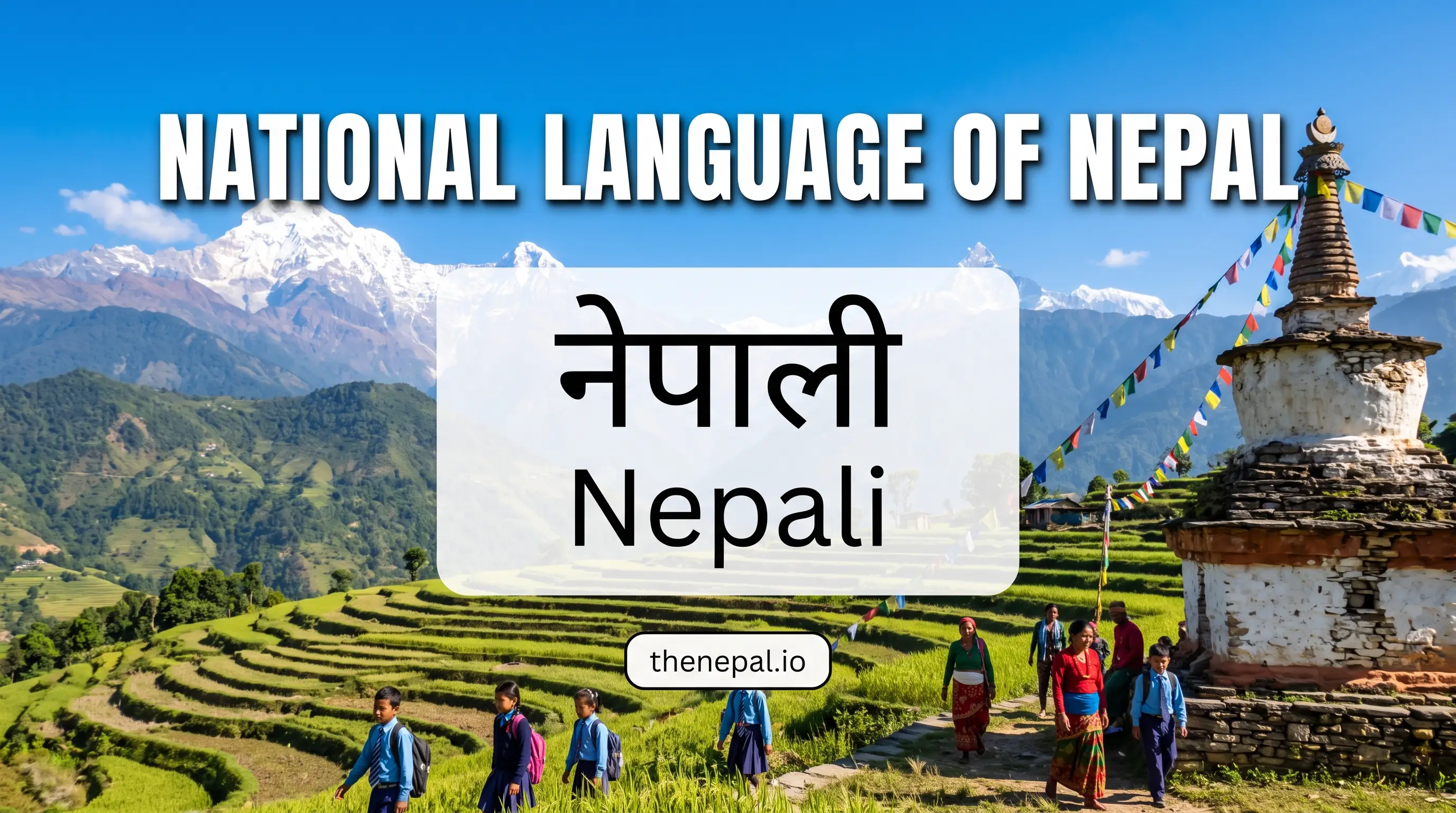
Ask what Nepal's national language is, and most people will simply say "Nepali" — and they wouldn't be wrong. But the Constitution actually draws a careful distinction that's easy to miss: Nepali is Nepal's official language for government business, while every mother tongue spoken in the country, from Maithili to Limbu to Nepal Bhasa, is constitutionally a language of the nation in its own right.
What the Constitution Actually Says
The Constitution of Nepal 2015 handles language in two separate articles, and the difference between them matters. Article 6 declares that all languages spoken as mother tongues in Nepal are languages of the nation — a sweeping recognition covering all 124 recorded mother tongues. Article 7 then narrows the focus: it designates Nepali in the Devanagari script as the official language of Nepal for federal government business, while allowing each province to adopt one or more additional official languages spoken by a majority within that province.
Two articles, two roles
Nepali in Devanagari script — used for federal government business nationwide.
All 124 mother tongues spoken in Nepal, each recognised as a national language.
In practice, this means "national language" and "official language" are not quite the same thing in Nepal's own legal terms, even though the two get used interchangeably in everyday conversation and in most casual references to Nepali as "the" national language.
Source: Constitution of Nepal 2015, Articles 6 and 7
How Nepali Got Here
Nepali's path to official status runs through more than a century and a half of legal changes. The country's first modern legal code, the Muluki Ain of 1854, recognised what was then called Gorkha Bhasa — now known as Nepali — as the sole official working language. The 1959 Constitution of the Kingdom of Nepal went further, naming Nepali the sole official and national language outright, with no room for other mother tongues.
That single-language framing held until the 2007 Interim Constitution, drafted after Nepal was declared a multi-ethnic, multilingual, multi-religious state. It kept Nepali as the sole official language but extended national-language status to every mother tongue spoken in the country — the same structure the 2015 Constitution carries forward today.
Script, Family and Everyday Use
Nepali is written in the Devanagari script, the same script used for Hindi and Sanskrit, and it belongs to the Pahari subgroup of the Indo-Aryan language family — making it a close relative of Hindi with heavy historical influence from Sanskrit. Before "Nepali" became the standard term, the language was known as Khaskura, the language of the Khas hill communities, and later as Gorkhali, the language of the Gorkha kingdom that unified much of present-day Nepal.
Today Nepali functions as the lingua franca that links Nepal's dozens of ethnic and linguistic communities, used in schools, media, courts and administration nationwide, even in regions where it isn't anyone's first language at home.
✦ Did you know?
- Nepal's 2021 census recorded 124 distinct mother tongues, with 13 newly identified since the 2011 census.
- The Rai community alone speaks roughly 30 related languages, some close enough to be considered dialects of one another.
- Since 2018, Nepali parliamentarians have been permitted to take their oath of office in their own mother tongue rather than Nepali.
Provincial Official Languages
Because Article 7 lets provinces adopt additional official languages, Nepal's Language Commission has recommended a set of languages for use alongside Nepali in each province, based on which languages have their own script and are spoken by more than 1% of the provincial population.
| Province | Recommended additional languages |
|---|---|
| Koshi | Maithili, Limbu |
| Madhesh | Maithili, Bhojpuri, Bajjika |
| Bagmati | Tamang, Nepal Bhasa (Newari) |
| Gandaki | Magar, Gurung |
| Lumbini | Tharu, Awadhi |
| Karnali | Khas Bhasa (Karnali dialect), Magar |
| Sudurpashchim | Dotyali, Tharu |
Source: Language Commission of Nepal; The Himalayan Times
Frequently Asked Questions
What is the national language of Nepal?
Nepali, written in the Devanagari script, is Nepal's official language under Article 7 of the Constitution of Nepal. The Constitution also recognises all mother tongues spoken in Nepal as languages of the nation under Article 6.
Is Nepali the only national language of Nepal?
Nepali is the sole official language at the federal level, but the Constitution recognises all 124 mother tongues spoken in Nepal as national languages, and individual provinces may adopt additional official languages of their own.
What script is Nepali written in?
Nepali is written in the Devanagari script, the same script used for Hindi and Sanskrit.
How many people speak Nepali?
According to the 2021 census, Nepali is the mother tongue of about 44.86 percent of Nepal's population and is spoken as a second language by a further 46.2 percent.
What language family does Nepali belong to?
Nepali belongs to the Pahari subgroup of the Indo-Aryan language family, making it closely related to Hindi, and it was historically known as Khaskura or Gorkhali before the name Nepali became standard.