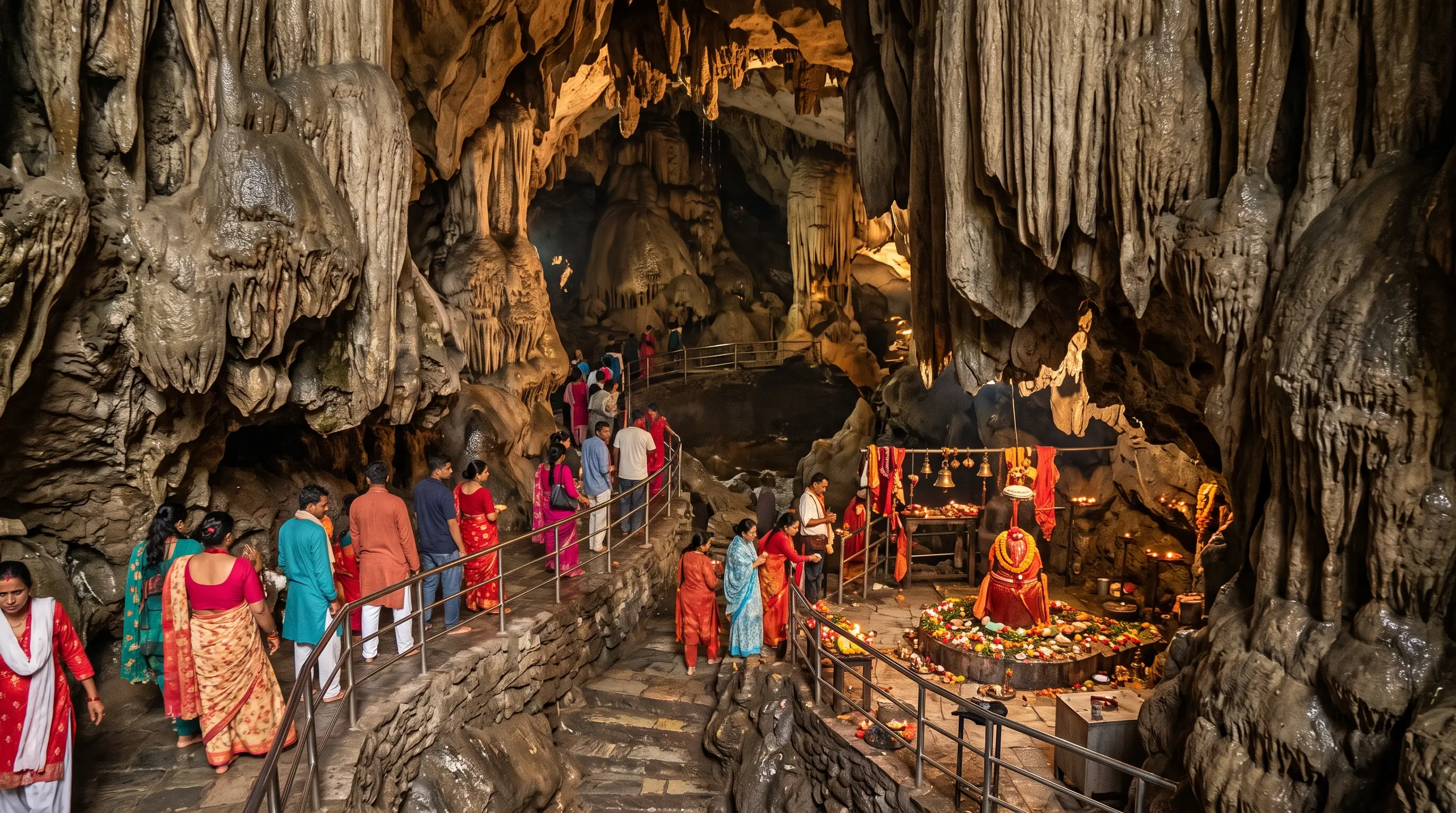
Tucked beneath the hill town of Bandipur in Tanahun district, Siddha Gufa is the cave most commonly named Nepal's national cave. At roughly 437 metres deep and up to 50 metres high, it's widely recognized as the largest natural limestone cave in the country and one of the largest in South Asia — a cathedral-like chasm of stalactites, stalagmites and resident bats that has drawn hikers, pilgrims and geologists alike since its discovery in 1988.
Siddha Gufa: Nepal's National Cave
Siddha Gufa stretches roughly 437 metres and rises up to 50 metres in places, making it the largest documented natural cave in Nepal and, by most accounts, the second-largest in South Asia. Inside, the limestone chamber opens into a vast, echoing space lined with stalactites and stalagmites, home to colonies of bats overhead and, at times, a resident sadhu performing prayers near the entrance. The cave is estimated to be around 3,500 years old geologically, though it wasn't discovered by the outside world until 1988, when a group of local hikers came across its entrance.
Reaching it requires a short trek from Bandipur — about 1½ hours downhill — or a steeper 45-minute climb up nearly 1,200 stairs from Bimalnagar on the Prithvi Highway. Locals strongly recommend hiring a guide and carrying a torch, since much of the interior has no artificial lighting, and the stone paths inside can be slippery.
✦ Did you know?
- Siddha Gufa's interior can reportedly hold up to 2,500–3,000 people at once, according to several local tourism sources.
- The cave contains idols of Lord Shiva and Nagarjuna, and devotees gather there during Mahashivratri.
- German speleologists first formally surveyed the cave in 1990–91; Hungarian scientists later documented its bat species in 1998.
Source: Lonely Planet; Wikipedia (Siddha Cave); Mountain Tiger Nepal; showcaves.com
Beyond Siddha Gufa
Nepal has no constitutional article naming a "national cave" the way it names Nepali the official language, so Siddha Gufa's status rests on its scale rather than a government decree. A few other caves come up often enough to be worth knowing alongside it — most notably the Sky Caves of Mustang, roughly 10,000 human-carved caves cut into cliffs above the Kali Gandaki River, holding 2,000–3,000-year-old burials and Buddhist art, and Gupteshwor Mahadev Cave in Pokhara, the country's most-visited sacred cave thanks to its Shiva shrine and its link to Davis Falls next door.
Two kinds of recognition
Symbols like the national flower, bird, animal and language carry formal government or constitutional recognition.
Named "national cave" by scale and popular consensus, without a formal act naming it so.
Source: Nepal Tourism Board; Wikipedia (Mustang Caves); HeritageDaily
Notable Caves Across Nepal
Academic surveys have documented 222 caves spread across 56 of Nepal's 77 districts, most of them karst limestone formations concentrated around Pokhara. Siddha Gufa tops the list for scale, but several others stand out for sanctity or accessibility.
| Cave | Location | Known for |
|---|---|---|
| Siddha Gufa | Bandipur, Tanahun | Nepal's largest known cave |
| Sky Caves of Mustang | Upper Mustang | ~10,000 ancient man-made caves |
| Gupteshwor Mahadev Cave | Pokhara | Sacred Shiva shrine; links to Davis Falls |
| Mahendra Cave | Pokhara | Limestone formations and shrine |
| Chamera (Bat) Cave | Pokhara | Large resident bat colony |
| Chobhar (Manjushree) Cave | Kathmandu Valley | Legendary origin site of the Valley |
| Halesi Mahadev Cave | Khotang district | Major Shiva pilgrimage site |
Source: Nepal Tourism Board; Mountain Tiger Nepal; Wonder Nepal
Frequently Asked Questions
What is the national cave of Nepal?
Siddha Gufa, near Bandipur in Tanahun district, is widely regarded as Nepal's national cave, thanks to its status as the country's largest known natural limestone cave. Worth noting: this rests on its scale and popular recognition rather than a formal constitutional designation, unlike Nepal's official national flower, bird, or animal.
What is the largest cave in Nepal?
Siddha Gufa is Nepal's largest known cave, at roughly 437 metres deep and up to 50 metres high, and is generally described as the second-largest cave in South Asia.
What are the Sky Caves of Mustang?
The Sky Caves of Mustang are a collection of around 10,000 human-made caves carved into cliffs in Nepal's Mustang district, containing burials, artifacts and Buddhist art dating back roughly 2,000–3,000 years. The site has been on UNESCO's tentative list since 1996.
How many caves are there in Nepal?
Academic research has documented 222 caves across 56 of Nepal's 77 districts, most of them karst limestone formations concentrated in the Pokhara region.
What is Gupteshwor Mahadev Cave?
Gupteshwor Mahadev Cave, in Pokhara near Davis Falls, is one of Nepal's most-visited caves thanks to its shrine dedicated to Lord Shiva. Its visitor-accessible route runs about 2,057 metres and includes a passage that connects to the river behind Davis Falls.