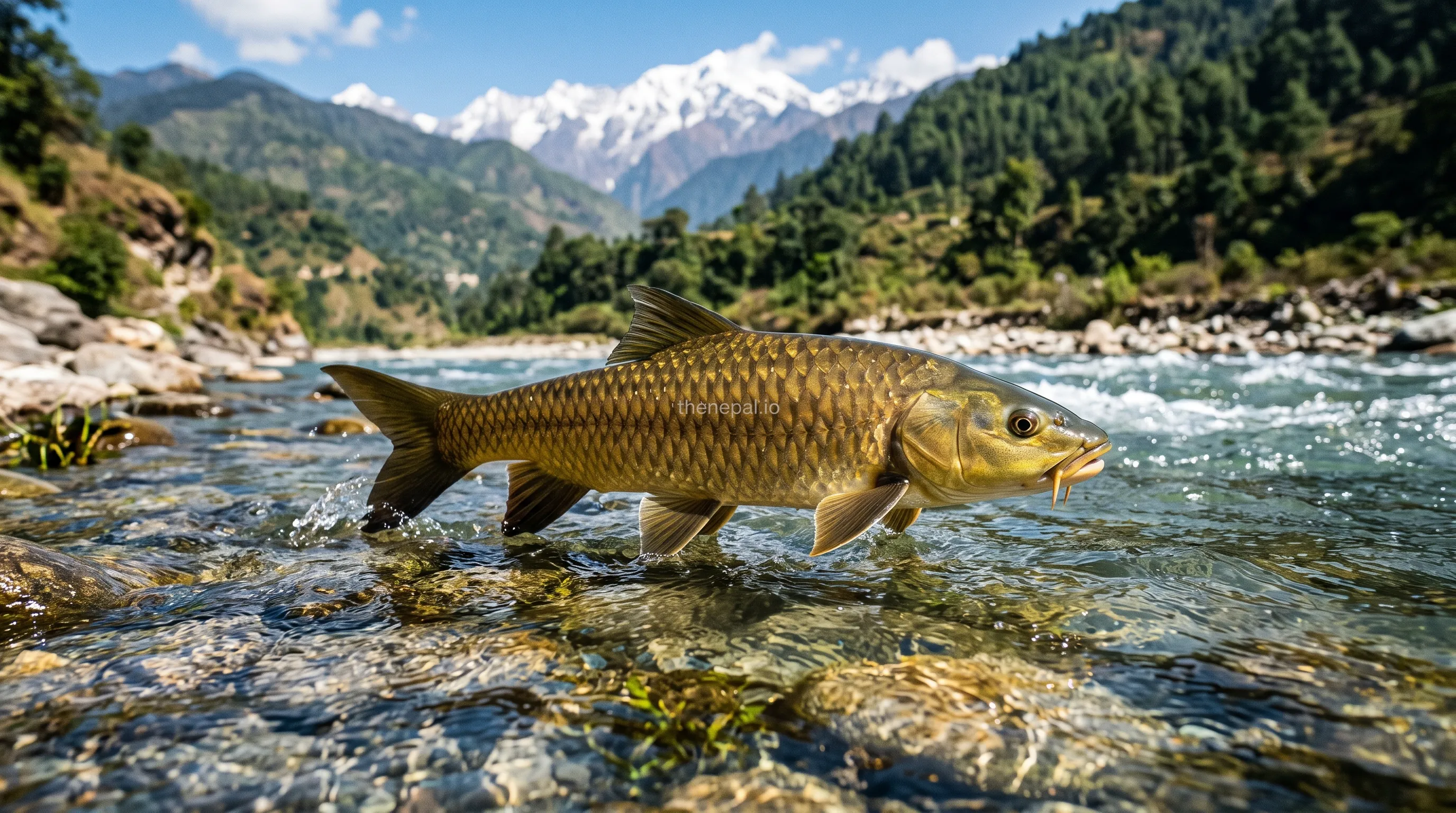
In the fast, cold rivers that drop out of the Himalaya, one fish has earned a reputation anglers, subsistence fishers and river communities all recognise: a thick-bodied, golden-scaled swimmer strong enough to be called the "tiger of the river." That fish, the Asala, is Nepal's national fish.
A Note on Naming: Asala vs. Sahar
Source: Nepal Agricultural Research Council (NARC); FAO Nepal fisheries country profile
Where It Lives
The Golden Mahseer favours fast-moving water and deep rocky pools across Nepal's mid-hill and lower Himalayan rivers, generally between about 200 and 2,000 metres elevation. It is found across all three of Nepal's major river systems:
Like salmon, Mahseer migrate upstream in the pre-monsoon and post-monsoon months to spawn, moving from larger rivers into smaller tributaries before returning downstream.
Size and Strength
Golden Mahseer is one of the largest freshwater game fish in South Asia. Most fish caught by anglers and subsistence fishers are well short of record size, but the species can grow dramatically larger in undisturbed pools.
How big does Asala get?
✦ Did you know?
- Anglers call the Golden Mahseer the "tiger of the river" for how hard it fights on a line.
- A large Mahseer can weigh more than an average adult human.
- Mahseer migrate upstream to spawn — one of the few Himalayan fish known to do this.
Other Important Native River Fish
The Asala shares Nepal's rivers with several other economically and culturally important native species:
| Nepali name | Scientific name | Notes |
|---|---|---|
| Sahar (Silver Mahseer) | Tor tor | Close relative, found in Gandaki & Mahakali |
| Katle | Neolissochilus hexagonolepis | Prized food and sport fish of hill rivers |
| Buche Asala (snow trout) | Schizothorax spp. | Cold-water species of higher elevations |
| Goonch | Bagarius yarelli | Large predatory catfish |
Source: Department of Fisheries survey data; NARC fisheries research division
Culture and Livelihoods
Along the Koshi, Gandaki and Karnali, fishing communities such as the Sonaha, Bote and Majhi have depended on native river fish including the Asala for generations, both for subsistence and small-scale trade. In many parts of Nepal, fish also carry religious significance — some temple ponds and river stretches are traditionally protected from fishing altogether.
In recent years, Golden Mahseer has also become the centrepiece of Nepal's growing sport-fishing tourism, drawing anglers to rivers like the Karnali, Seti and Babai for catch-and-release expeditions.
Conservation Status
The Golden Mahseer is listed as Endangered, with wild populations under sustained pressure from hydropower dams blocking migration routes, overfishing, and degraded water quality downstream of settlements. Because Mahseer must move freely between river stretches to spawn, dam construction has been especially disruptive to the species across its Himalayan range.
Conservation efforts are gaining ground: in January 2026, Rajapur and Tikapur municipalities jointly declared Nepal's first community-led Fish Sanctuary on the Lower Karnali River, protecting roughly 390 hectares of critical breeding and nursery habitat for the Golden Mahseer and other native species, developed with WWF Nepal and local Sonaha and Tharu communities.
Source: IUCN Red List; WWF Nepal, Lower Karnali Fish Sanctuary declaration (January 2026)
Frequently Asked Questions
What is the national fish of Nepal?
Nepal's national fish is the Asala, popularly identified with the Golden Mahseer (Tor putitora), a large river fish found across Nepal's major river systems.
Is Asala the same fish as Sahar?
The names overlap in everyday use. In fisheries science, Sahar specifically refers to the Golden Mahseer (Tor putitora), while Asala more precisely refers to snow trout species (Schizothorax spp.); both names are used loosely for river game fish in different regions of Nepal.
How big can Nepal's national fish grow?
Golden Mahseer can reach up to about 2.7 metres in exceptional cases, though most wild catches range from 30 centimetres to just under 2 metres, with large specimens weighing over 50 kilograms.
Which rivers is the Golden Mahseer found in?
It is found across Nepal's major river systems including the Koshi, Gandaki (with the Kaligandaki and Trisuli), and Karnali (with the Seti), typically in fast-flowing water and deep pools.
Is the Golden Mahseer endangered?
Yes. The Golden Mahseer is listed as Endangered, with populations declining due to dam construction, overfishing and habitat degradation across its Himalayan range.