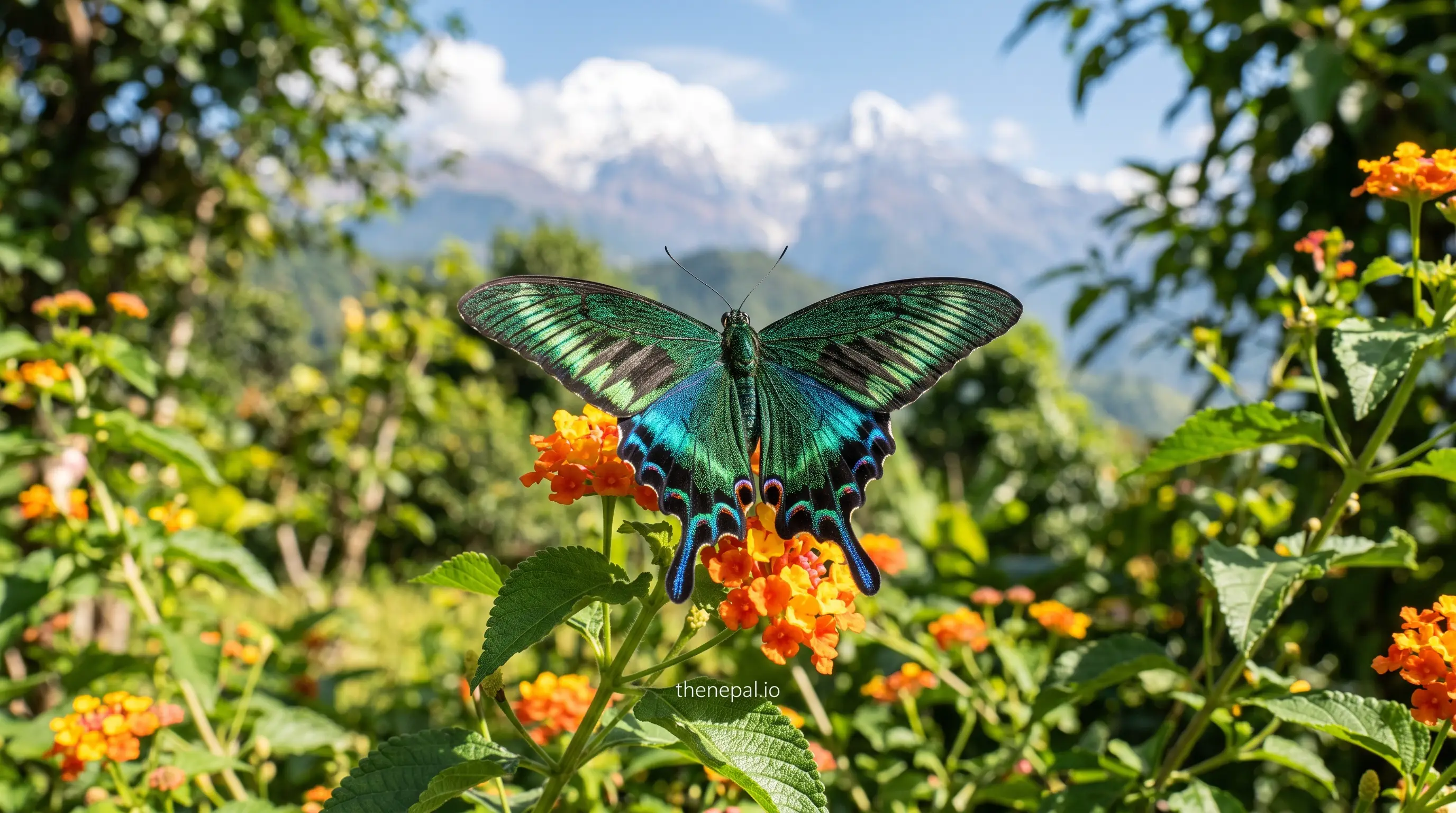
Nepal has more than 650 recorded butterfly species packed into a country the size of England — an astonishing density that draws lepidopterists from around the world. Among them, one swallowtail keeps coming up whenever the conversation turns to a symbol: the Krishna Peacock, prized for wings that seem to hold a slice of peacock plumage inside a butterfly's frame.
Why the Krishna Peacock Is Proposed as Nepal's National Butterfly
Nepal's officially declared national symbols are relatively few — the rhododendron as national flower, the cow as national animal, and the Himalayan Monal as national bird among them. A national butterfly has never been formally legislated. The Krishna Peacock has nonetheless become the de facto answer whenever the question comes up, championed by Nepal's community of butterfly researchers and conservationists for its size, striking colouration and status as one of the country's most photographed swallowtails.
Part of its appeal as a symbol is thematic: its species name honours the Hindu deity Krishna, who is closely associated with peacock feathers in iconography, and the butterfly's iridescent blue-green patches echo that connection directly. It ties a native insect to a widely recognised cultural reference point in a way few other Himalayan butterflies do.
Source: Inside Himalayas; Butterflies of Nepal research community
What It Looks Like
The Krishna Peacock is a large, dramatic swallowtail. Its black forewings carry a fine dusting of green scales and a narrow yellow band running parallel to the body, while the hindwings open into a broad, metallic blue-green patch bordered by a curved yellow band and a row of red-mauve crescents near the edge.
Forewing base
Black, dusted with fine green scales for a subtle sheen.
Hindwing patch
Large metallic blue-green discal patch, the butterfly's signature feature.
Discal bands
Yellow bands crossing both wings, with red-mauve crescents near the margin.
It is frequently confused with two close relatives — the Blue Peacock (Papilio arcturus) and the Paris Peacock (Papilio paris) — which share the same general swallowtail silhouette and blue-green colouring but differ in the size and shape of the hindwing patch.
Telling it apart from close relatives
| Look-alike species | Key difference |
|---|---|
| Blue Peacock (Papilio arcturus) | Larger, more extensive blue patch across the hindwing |
| Paris Peacock (Papilio paris) | Rounder, more concentrated blue-green patch; coarser green scaling |
Naming and Discovery
Papilio krishna was first formally described in 1857 by the British entomologist Frederic Moore, based on specimens collected in the eastern Himalayan region. The species sits within the "paris species group" of swallowtails, a cluster of large, iridescent Papilio species found across South and Southeast Asia that share the same elongated forewings and shimmering wing scaling.
✦ Did you know?
- Nepal is home to over 650 recorded butterfly species — roughly ten times the count found in an area the size of Britain.
- The Krishna Peacock belongs to the same "paris group" of swallowtails as the Blue Peacock and Paris Peacock, all prized for their metallic wing sheen.
- Its species name directly references the Hindu deity Krishna's association with peacock feathers, linking the insect to a widely known cultural symbol.
Habitat and Where to See It
The Krishna Peacock lives in mid-elevation Himalayan forest, generally between about 900 and 2,700 metres, across Nepal, north-east India, Bhutan, China, Myanmar and Vietnam. Within Nepal, birders and butterfly-watchers most commonly report sightings around forested ridgelines in the mid-hills.
- Phulchowki, Kathmandu Valley — a well-known butterfly-watching peak with rich swallowtail diversity.
- Godavari — botanical gardens and forest edge habitat near Kathmandu.
- Annapurna foothills near Pokhara — mid-elevation forest along popular trekking routes.
- Chitwan National Park buffer zones — lower-elevation forest with high overall butterfly diversity.
Conservation Status
The Krishna Peacock is classified as uncommon rather than formally threatened, but it faces mounting pressure from habitat loss across parts of its Himalayan range, including deforestation linked to tourism infrastructure, road construction and quarrying in Nepal's mid-hills. Like other large, strikingly coloured swallowtails, it is also sought after in the butterfly trade, which adds further pressure on wild populations in some areas.
Source: IUCN Red Data Book; Grokipedia summary of Papilio krishna research
Frequently Asked Questions
What is the national butterfly of Nepal?
The Krishna Peacock, scientifically named Papilio krishna, is popularly regarded as Nepal's national butterfly, though it has not been formally declared by an act of the Nepali government the way the national flower or bird have been.
Is the Krishna Peacock officially Nepal's national butterfly?
No official designation has been enacted. It is widely proposed and popularly cited as the national butterfly, and it appears in many lists of Nepal's symbols, but it lacks the formal legal status of symbols like the rhododendron or the cow.
Why is it called the Krishna Peacock?
Its species name honours the Hindu deity Krishna, who is closely associated with peacock feathers, reflecting the butterfly's iridescent blue-green wing markings that echo peacock plumage.
Where is the Krishna Peacock found?
It lives in Himalayan forests between roughly 900 and 2,700 metres elevation across Nepal, India, Bhutan, China, Myanmar and Vietnam.
Is the Krishna Peacock endangered?
It is classified as uncommon rather than formally threatened, though it faces pressure from habitat loss and is sought after in the butterfly trade.