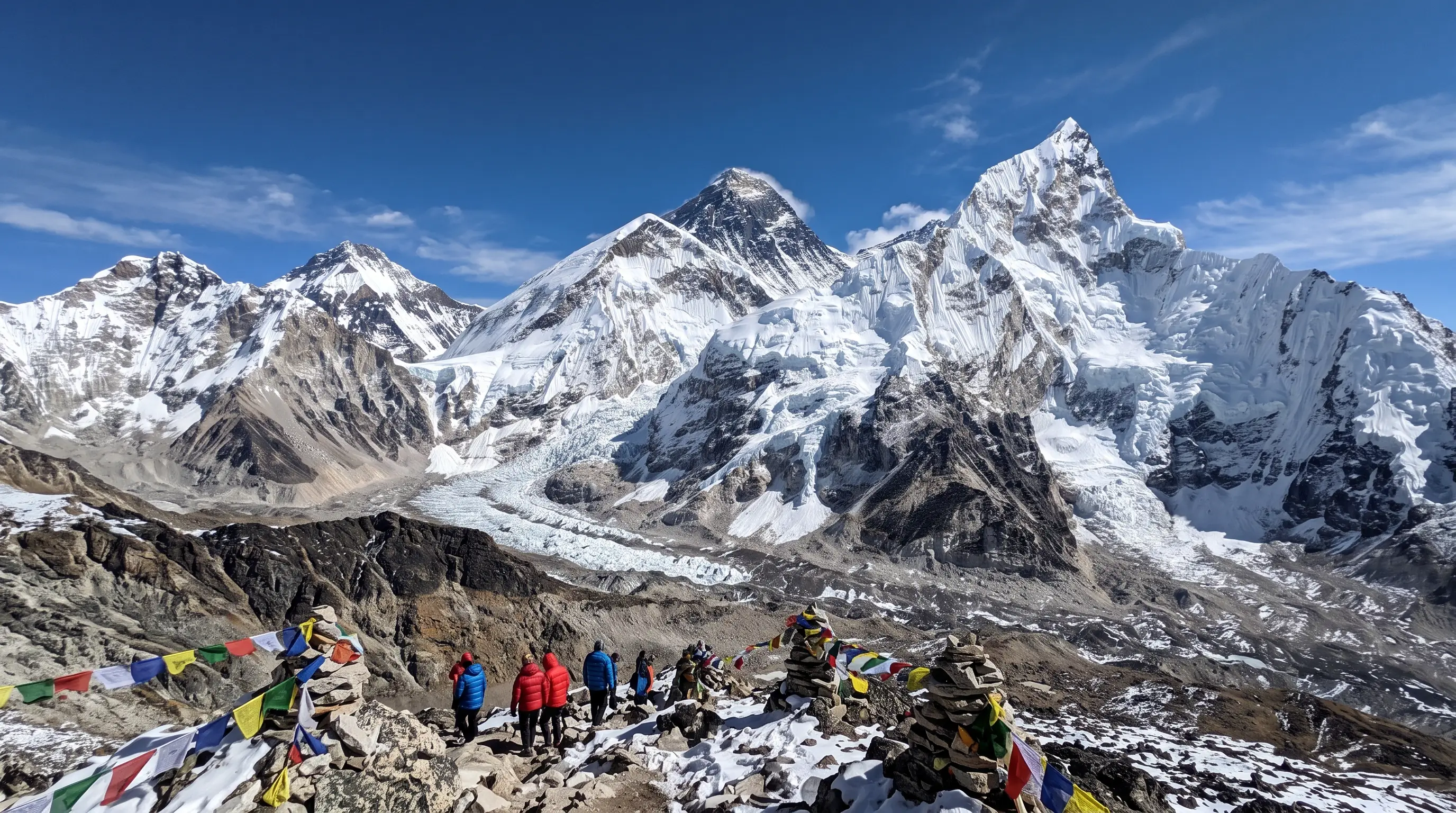
There's no article of Nepal's Constitution that names a national mountain, the way Article 7 names Nepali the official language. But "national Everest" isn't quite the empty phrase "national cave" or "national dance" turned out to be, either. Nepal's government took a real, documented, official action on this exact mountain: in the 1960s it formally adopted Sagarmatha as Everest's Nepali name, on the recommendation of historian Baburam Acharya. That single act of naming is closer to an official symbol status than any other mountain in the country has ever received.
Two Names, Two Kinds of Authority
Everest carries more official names than almost any landmark on Earth, but two matter most to Nepal's own claim on the mountain.
Government-adopted vs. internationally used
Proposed by historian Baburam Acharya and formally adopted by the Nepali government as the mountain's official Nepali name — part of a wider effort to use indigenous names for the country's geography.
Named by Britain's Royal Geographical Society after Sir George Everest, a former Surveyor General of India — despite Everest's own objection that the peak should carry a local name.
Across the border, Tibetans have called the mountain Chomolungma, "Mother Goddess of the World," for centuries — the oldest of the names still in wide use today.
Source: Ace the Himalaya; alanarnette.com; Montana State University Everest Education Expedition
From Peak XV to the Roof of the World
Everest entered the historical record not as a mountain but as a number. British surveyors working the Great Trigonometric Survey of India spotted it from more than 140 miles away in Darjeeling and, unable to enter Nepal or Tibet to confirm a local name, catalogued it first as "Peak b," then as "Peak XV." In 1856 the survey's calculations confirmed it as the world's highest point, and in 1865 the Royal Geographical Society settled on "Mount Everest" for the English-language record.
Nepal's own relationship with the mountain deepened through the 20th century. The country's government adopted Sagarmatha as the official Nepali name in the 1960s, gazetted the surrounding area as Sagarmatha National Park in 1976, and saw that park inscribed as a UNESCO World Heritage Site in 1979 — recognition that credits both its dramatic glaciers and peaks and the resident Sherpa culture. On 29 May 1953, Edmund Hillary and Tenzing Norgay became the first climbers confirmed to reach the summit, via the South Col route.
✦ Did you know?
- In 2020, Nepal and China jointly agreed on Everest's height for the first time, settling on 8,848.86 metres after years of differing national measurements.
- Everest is still rising by roughly 4 millimetres a year, pushed up as the Indian tectonic plate continues to slide beneath Asia.
- Sagarmatha National Park is home to more than 2,500 Sherpa residents alongside rare species like the snow leopard and red panda.
Source: UNESCO World Heritage Centre; alanarnette.com; discoveryworldtrekking.com
Nepal's Other Giants
Everest doesn't stand alone. Nepal is home to eight of the world's fourteen mountains over 8,000 metres — a concentration of extreme altitude found nowhere else on the planet.
| Mountain | Height | World rank |
|---|---|---|
| Sagarmatha (Everest) | 8,848.86 m | 1st |
| Kangchenjunga | 8,586 m | 3rd |
| Lhotse | 8,516 m | 4th |
| Makalu | 8,485 m | 5th |
| Cho Oyu | 8,188 m | 6th |
| Dhaulagiri | 8,167 m | 7th |
| Manaslu | 8,163 m | 8th |
| Annapurna I | 8,091 m | 10th |
Source: Montana State University Everest Education Expedition
Frequently Asked Questions
What is the national mountain of Nepal?
Nepal has no officially designated "national mountain." Sagarmatha (Mount Everest) is the closest thing to one, since it's the only peak with a government-adopted Nepali name, a dedicated national park, and UNESCO World Heritage status.
What is Mount Everest called in Nepal?
In Nepal, Mount Everest is officially called Sagarmatha, meaning "Forehead of the Sky." The name was proposed by historian Baburam Acharya and formally adopted by the Nepali government in the 1960s.
How tall is Mount Everest?
Mount Everest's height is 8,848.86 metres, based on a joint survey announcement by Nepal and China in December 2020 — the first time the two countries agreed on a single official figure.
When was Everest first climbed?
Edmund Hillary of New Zealand and Tenzing Norgay, a Nepali Sherpa, became the first confirmed climbers to reach Everest's summit on 29 May 1953, via the South Col route.
How many of the world's tallest mountains are in Nepal?
Nepal is home to eight of the world's fourteen mountains that rise above 8,000 metres, including Everest, Kangchenjunga, Lhotse, Makalu, Cho Oyu, Dhaulagiri, Manaslu and Annapurna I.