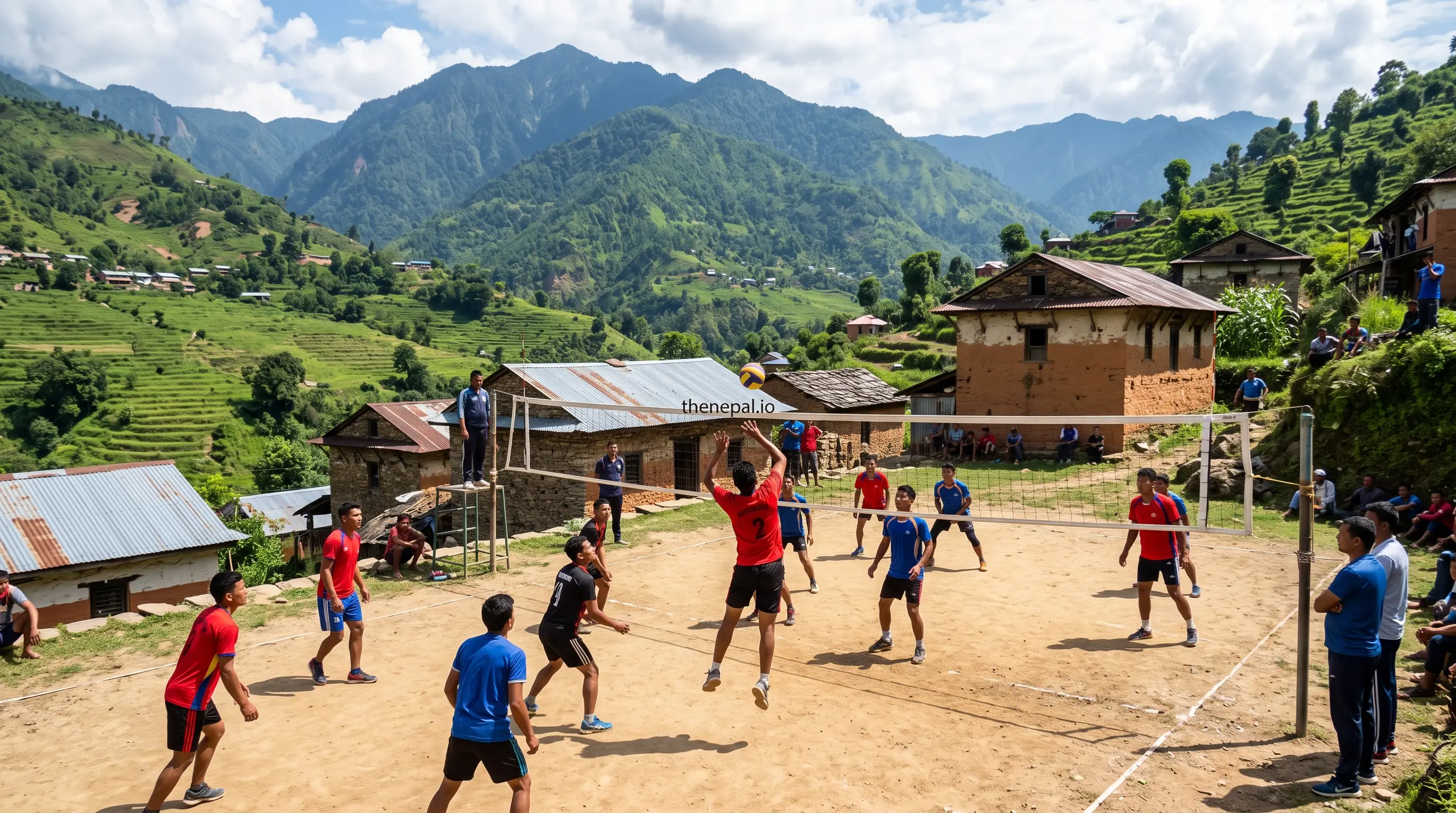
Drive through almost any Nepali town or village and you'll spot a volleyball net strung between two poles, often improvised from bamboo, with a game underway regardless of the hour. That everyday ubiquity is exactly why, on 23 May 2017, the government made official what was already true in practice: volleyball is Nepal's national sport.
How Volleyball Became Official
On 23 May 2017, a Cabinet meeting held at the Prime Minister's residence in Baluwatar formally decided to recognise volleyball as the national sport of Nepal, acting on a proposal forwarded by the Ministry of Youth and Sports. The decision was announced by the government spokesperson at the time, then-Minister for Information and Communications Surendra Kumar Karki, and followed years of lobbying by the Nepal Volleyball Association, which had argued the game's low cost and adaptability to Nepal's terrain made it the natural choice.
Before this decision, no sport held official national-sport status in Nepal — Dandi Biyo and kabaddi were only informally regarded as national games. The designation gave volleyball a formal status alongside Nepal's other national symbols, and it has since been used to justify greater government investment in courts, coaching and domestic tournaments meant to build competitive strength at home and internationally.
Source: Cabinet decision, reported by Onlinekhabar · Ministry of Youth and Sports, Government of Nepal
Official Sport vs. Traditional Game
Two different traditions
Nepal's officially declared national sport, governed by the Volleyball Association of Nepal and played competitively nationwide.
A traditional stick-and-peg game long associated with rural Nepal, popularly called a national game though never given official status.
Before volleyball's formal declaration, Dandi Biyo — a game played with two sticks, a smaller peg struck and launched with a longer stick — was often informally referred to as Nepal's national game. It remains a beloved village pastime and a marker of rural Nepali childhood, even though it was never granted the legal national-sport status that volleyball now holds.
Volleyball's Reach in Nepal
Volleyball's rise owes much to its low barrier to entry: a net, a ball and a patch of flat ground are enough to start a game, making it accessible in places where football pitches or cricket grounds are harder to maintain. The Nepal Army and Nepal Police have historically fielded some of the country's strongest teams, and inter-district and national tournaments draw enthusiastic local followings.
Nepal's national volleyball teams, both men's and women's, compete in South Asian regional tournaments, and the sport continues to be a fixture of school sports days and community festivals across the country.
✦ Did you know?
- Volleyball courts in rural Nepal are often improvised, using bamboo poles and hand-strung nets rather than official equipment.
- The Nepal Army and Nepal Police have long been considered among the country's strongest domestic volleyball teams.
- Dandi Biyo, the traditional game once informally called a national pastime, is still played in many villages during festival seasons.
Popular Sports in Nepal
While volleyball holds official national-sport status, several other sports command large followings across the country.
| Sport | Status in Nepal |
|---|---|
| Volleyball | Official national sport (since 23 May 2017) |
| Football (soccer) | Highly popular, strong club and school following |
| Cricket | Rapidly growing popularity, especially in urban areas |
| Kabaddi | Popular traditional team sport |
| Dandi Biyo | Traditional rural game, no official status |
Frequently Asked Questions
What is the national sport of Nepal?
Volleyball is the official national sport of Nepal, formally declared by the Government of Nepal's Cabinet on 23 May 2017 following a proposal from the Ministry of Youth and Sports.
When did volleyball become Nepal's national sport?
The Government of Nepal's Cabinet officially designated volleyball as the national sport on 23 May 2017, recognising its widespread popularity from villages to cities across the country.
Which body governs volleyball in Nepal?
The Volleyball Association of Nepal is the national governing body responsible for organising domestic competitions and overseeing Nepal's national volleyball teams.
Was there a traditional national sport before volleyball?
Before volleyball's official designation, Dandi Biyo, a traditional stick-and-peg game, was often popularly regarded as Nepal's traditional national game, though it never held official government status.
Why was volleyball chosen as Nepal's national sport?
Volleyball was chosen because of its exceptional grassroots popularity across Nepal's hills, plains and urban centres, requiring minimal equipment and being played informally in villages, schools and army barracks nationwide.