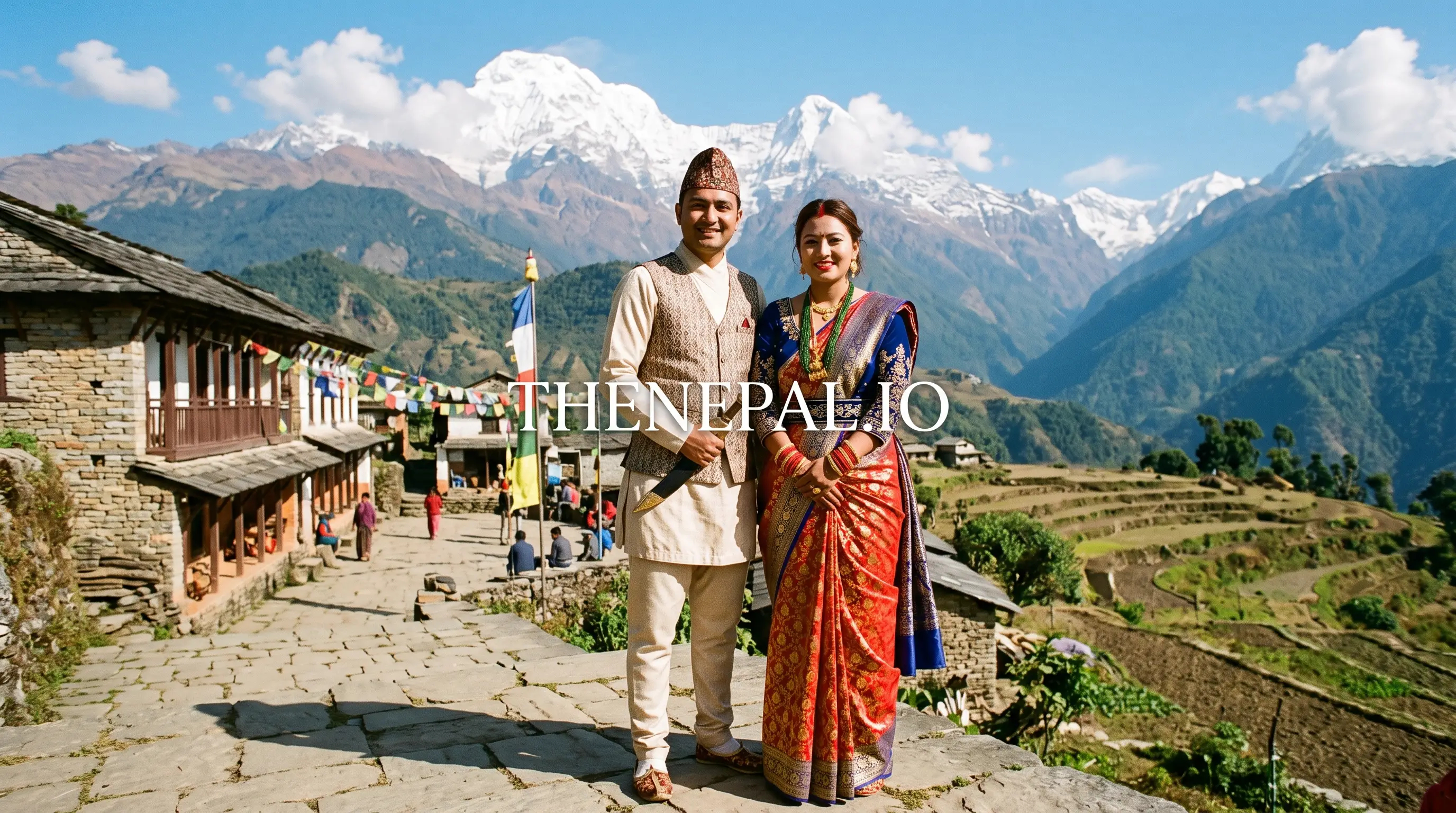
Ask what Nepalis traditionally wear, and most people picture the Daura Suruwal and Dhaka topi worn by men — but the fuller picture includes Gunyu Cholo, the traditional dress worn by women, and a wardrobe of regional variations that reflect Nepal's ethnic diversity as much as any single national uniform does.
Components of the National Dress
For men, the outfit centres on the Daura, a closed-neck, double-breasted garment tied with strings on one side rather than buttons, paired with the Suruwal, a fitted trouser that narrows at the ankle. A Dhaka topi — a brimless cap woven from colourful handloom Dhaka fabric — completes the look, often finished with a waistcoat or a Nepali coat for formal settings.
Men's and women's traditional dress
Tied tunic and fitted trousers, worn with a Dhaka topi cap and often a waistcoat.
A wrap-around skirt and fitted blouse, worn with a Majetro shawl; the red sari is also common formal wear.
Women's traditional dress varies more by community, with Gunyu Cholo associated with Khas hill traditions, while the red sari with a green border is widely recognised as formal wear for married Nepali women, especially during festivals such as Teej.
Origins and Political History
Daura Suruwal rose to prominence as court and administrative dress during the Rana and Shah era, when it signalled rank and loyalty within the palace hierarchy. It was later formalised as the required dress for citizenship certificate photographs and government office, cementing its status as a marker of Nepali national identity through much of the 20th century.
Following Nepal's political changes in the 2000s and the shift toward a more inclusive, multi-ethnic national identity, the legal requirement to wear Daura Suruwal for official documents and public office was relaxed, opening space for other ethnic and regional dress to be recognised alongside it.
Fabric, Craft and Everyday Use
The Dhaka topi takes its name from Dhaka cloth, a handwoven textile historically associated with weaving traditions in eastern Nepal, prized for its intricate geometric patterns produced on traditional looms. This same fabric is also used for shawls, panchey and other accessories tied to the national dress tradition.
While everyday clothing in Nepal today leans heavily toward Western-style shirts, trousers and dresses, Daura Suruwal, Gunyu Cholo and Dhaka topi remain firmly in use for weddings, Dashain and Tihar celebrations, cultural performances and formal state functions.
✦ Did you know?
- The Daura traditionally has eight strings, symbolically linked to the eight forms of the goddess Ashtamatrika.
- Dhaka Topi Day is celebrated annually to promote the cap as a symbol of Nepali identity and support local weavers.
- Regional communities such as the Newar, Gurung, Magar and Rai each maintain their own distinct traditional dress alongside Daura Suruwal.
Key Garments at a Glance
The national dress tradition is built from a small set of recognisable garments and accessories, each carrying its own name and role.
| Garment | Worn by | Role |
|---|---|---|
| Daura | Men | Tied upper tunic |
| Suruwal | Men | Fitted trousers |
| Dhaka topi | Men | Handwoven cap |
| Gunyu Cholo | Women | Wrap skirt and blouse |
| Majetro | Women | Traditional shawl |
| Red sari | Women | Formal festival wear |
Frequently Asked Questions
What is the national dress of Nepal?
The national dress of Nepal is Daura Suruwal for men, paired with the Dhaka topi cap, and Gunyu Cholo (also called the Haku Patasi in some communities) for women, often worn with a shawl called a Majetro.
What does Daura Suruwal consist of?
Daura Suruwal consists of a Daura, a closed-neck, double-breasted upper garment tied with strings on one side, and a Suruwal, a fitted trouser worn underneath, traditionally completed with a Dhaka topi cap.
What do women traditionally wear as national dress in Nepal?
Women traditionally wear Gunyu Cholo, a wrap-around skirt paired with a fitted blouse, along with a Majetro shawl, though the red sari is also widely recognised as formal traditional wear for Nepali women, especially among Khas hill communities.
Why is Daura Suruwal significant historically?
Daura Suruwal was adopted as court and administrative dress during the Rana and Shah era and later required for national identity documents and formal state functions, making it closely tied to Nepal's political and cultural history.
Is the national dress still required in Nepal today?
Daura Suruwal and the Dhaka topi are no longer legally mandatory for citizenship photographs or public office, but they remain widely worn during festivals, weddings and cultural events, and Dhaka topi day is observed annually to celebrate the tradition.