The Only National Flag on Earth That Isn't a Rectangle
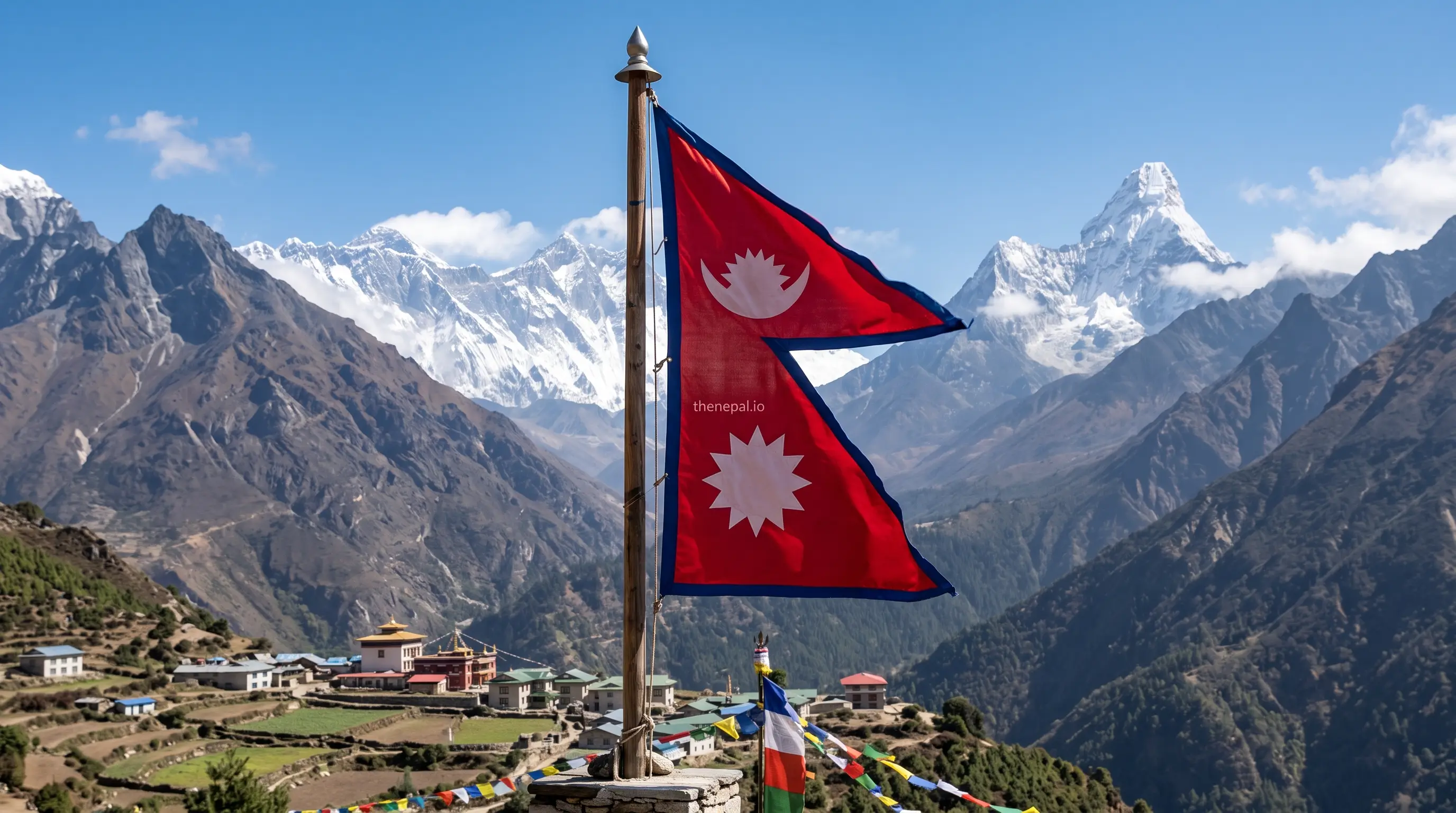
Nepal's flag is built from two stacked crimson pennants, crowned with a moon and a sun. It is the single non-quadrilateral national flag in use anywhere in the world — a geometric fact, not a metaphor, fixed by formula in Nepal's constitution.
In short
The national flag of Nepal is the world's only non-rectangular national flag, formed of two stacked crimson pennants bearing a moon and a sun, bordered in blue. Its geometric construction is fixed precisely by Nepal's constitution. The current simplified form was codified in 1962; the crimson echoes the rhododendron, Nepal's national flower, and the blue border represents peace.
Quick Facts
| National Flag | Two stacked crimson pennants with a blue border, moon and sun |
| Nepali Name | नेपालको राष्ट्रिय ध्वजा |
| Shape | Double pennant (non-quadrilateral) — the only one of its kind among national flags |
| Colours | Crimson red field, deep blue border, white emblems |
| Symbols | Crescent moon (upper pennant), twelve-rayed sun (lower pennant) |
| Adopted (current form) | 16 December 1962, with the 1962 constitution |
| Construction Method | Defined geometrically by a method in the constitution, not free-form art |
| Symbolism of Red | The rhododendron, Nepal's national flower, and the bravery of its people |
| Symbolism of Blue Border | Peace |
| Legal Status | Defined precisely in the Constitution of Nepal, Schedule 1 |
A Flag Defined by a Formula, Not a Free Hand
Most national flags are rectangles filled with stripes, crosses or charges. Nepal's is the lone exception: two pennants, one stacked above the other, inspired by Hindu dhvaja religious banners and, in many accounts, created in the time of Prithvi Narayan Shah. Where most flags can be redrawn loosely and still pass, Nepal's constitution fixes its outline with an explicit geometric construction — meaning that, in principle, no two correctly drawn Nepali flags can disagree on shape.
That unusual rigor is part of what makes the flag a genuine outlier in vexillology, the study of flags: it is simultaneously the most mathematically defined and the most visually distinct flag in use by any country today.
Geometry of the Flag
- Draw the left edge (the flagpole side) as a straight vertical line of a chosen length.
- From its base, mark a point partway up to begin the lower pennant's diagonal.
- Construct the upper pennant as a triangle, then the lower pennant as a second, slightly larger triangle directly beneath it.
- Trim the outer points of both pennants using a defined offset, producing the flag's signature folded-looking tips.
- Inset a blue border of fixed width along the entire outline.
- Place the moon emblem in the centre of the upper pennant and the sun emblem in the centre of the lower pennant.
This step-by-step geometric method (the steps above are a simplified summary — Schedule 1 gives the official construction) is unusual among national flags — most countries specify proportions, not full geometric construction. The approach guarantees the same silhouette regardless of who draws it, which is part of why the shape has stayed unchanged even as the emblems inside it were simplified in 1962.
Colours & What They Represent
Why the Sun and Moon?
Set in the upper pennant, the moon stands for Nepal's cool, shaded climate and carries the hope that the nation will endure for as long as the moon exists in the sky.
Set in the lower pennant, the sun stands for the intense heat of the southern lowlands and the same wish for permanence, mirroring the moon's symbolism.
History of the Flag
The double pennant is a combination of two individual pennons used by rival branches of the ruling dynasty. Many accounts credit King Prithvi Narayan Shah with creating it after unification, and its shape is inspired by Hindu dhvaja religious banners.
Earlier versions of the flag carried human faces in the sun and moon (some historians credit Jung Bahadur Rana with introducing them). The faces were removed in 1962, when the current design was adopted with the new constitution.
Timeline
Triangular red pennons are used as banners by the rulers of the hill principalities, including Gorkha.
After Prithvi Narayan Shah unifies the principalities, the double pennant becomes the standard flag.
The sun and moon carry human faces; some historians credit Jung Bahadur Rana with introducing them.
The faces are removed to modernise the flag, and the 1962 constitution adopts the current design on 16 December.
The 1990 and 2015 constitutions both contain geometric specifications for the flag, which is still cited internationally as the only non-rectangular national flag.
Legal Status & Flag Protocol
- 1Constitutional definition: Schedule 1 of the Constitution of Nepal sets out a specific method of making the national flag. See how the 24 steps work →
- 2Correct construction: official versions are expected to follow the prescribed geometric method rather than free reproduction.
- 3Respectful display (general flag etiquette): the flag is expected to be flown intact and undamaged, and never allowed to touch the ground.
- 4National observances (general practice): the flag is prominently displayed on government buildings during national holidays and official ceremonies.
Nepal's Flag vs. Typical National Flags
| Feature | Nepal | Most Countries |
|---|---|---|
| Overall Shape | Double pennant (non-rectangular) | Rectangle |
| Defined By | Full geometric construction | Width-to-height ratio only |
| Core Emblems | Moon and sun | Stars, crosses, stripes, or charges |
| Historical Root | Combined ruling-house pennants | Often derived from European flag traditions |
Interesting Facts
Frequently Asked Questions
It is made of two stacked pennants, a shape inherited from historic Hindu banner traditions, making it the only non-quadrilateral national flag in the world.
The moon represents Nepal's cool climate and a wish for the nation to last as long as the moon exists; the sun represents the heat of the lowlands with the same meaning.
The current flag was adopted on 16 December 1962 with the new constitution, which codified its geometric form.
Crimson red fills both pennants, bordered in deep blue, with white sun and moon emblems.
It echoes the rhododendron, Nepal's national flower, and is associated with bravery.
The deep blue border represents peace and harmony.
By a step-by-step geometric construction method set out in Schedule 1 of the Constitution of Nepal, not just a width-to-height ratio.
Yes, it is the only national flag in current use that is not a quadrilateral.
No — the sun and moon had human faces until 1962, when they were removed to modernise the flag.
It is a combination of the two pennons used by rival branches of the ruling dynasty; many accounts credit Prithvi Narayan Shah with creating the double pennant.
The flag is taller than it is wide. Its proportions are not a simple ratio: they follow from the geometric construction in the Constitution of Nepal, and the red field alone fits a 3:4 (width:height) rectangle.
The cow, sacred in Hindu tradition and central to Nepali farming life.
The Himalayan Monal (Danphe), known for its iridescent plumage.

Madan KC
Madan writes about Nepal's national symbols, history and culture at The Nepal, and runs the "The Nepal" YouTube channel. Research and editorial support from The Nepal team.
References
- Constitution of Nepal, Schedule 1 — flag construction
- Government of Nepal — official portals on national symbols
- Flag Institute & vexillological references
- Encyclopaedia Britannica
- Nepal Tourism Board cultural resources
- Peer-reviewed historical and cultural studies journals