
National Animal of Nepal: The Sacred Cow
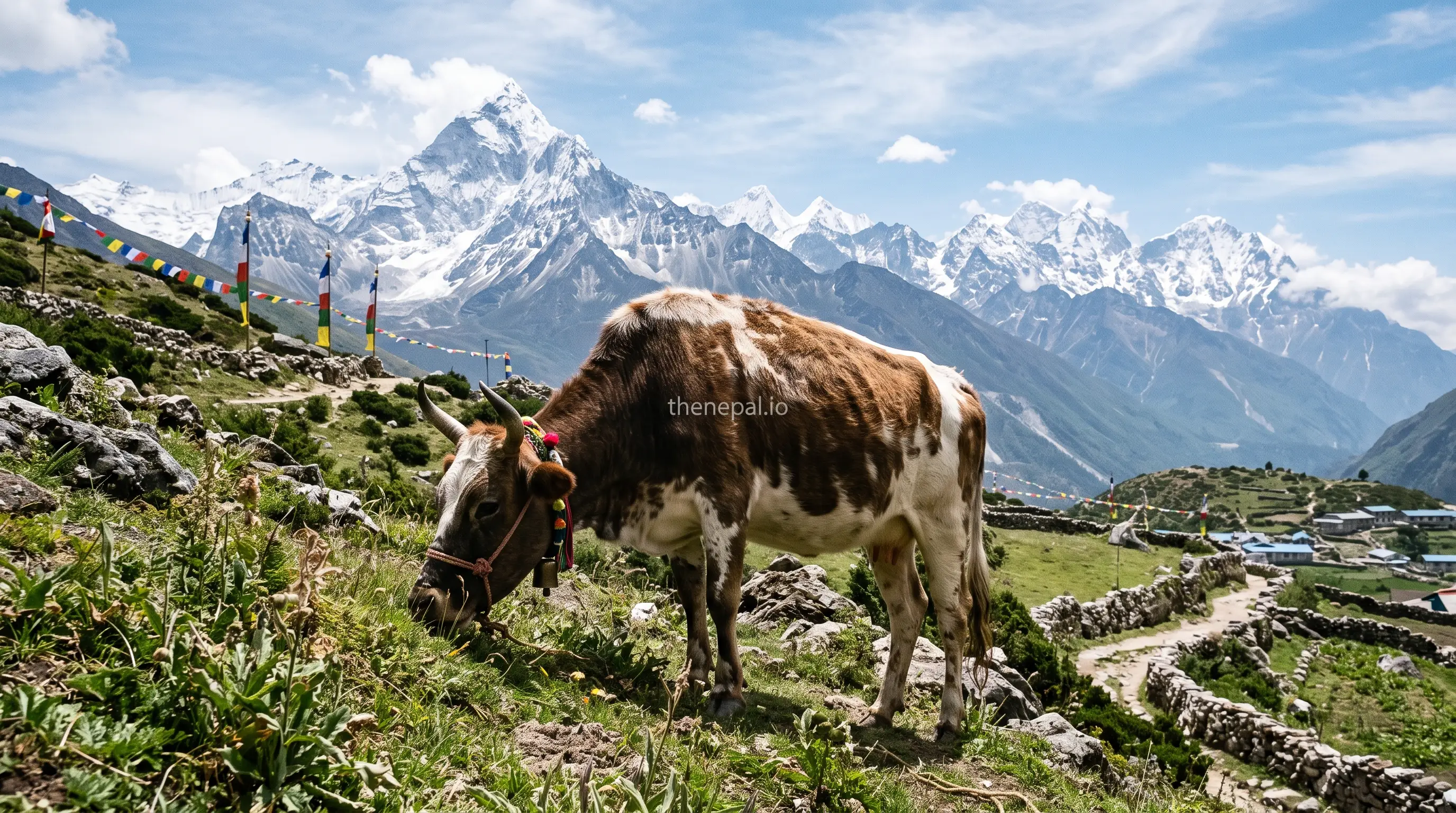
In Nepal the cow — गाई (gāī) — is far more than livestock. It is the country's official national animal, worshipped as an embodiment of Goddess Lakshmi, protected by law, and central to farming life from the Terai plains to the high Himalayan pastures.
In short
The cow is the national animal of Nepal, sacred in Hindu tradition and associated with Goddess Lakshmi. It is legally protected from slaughter, honoured every year at the Gai Tihar and Gai Jatra festivals, and remains central to Nepali farming, dairy and rural life from the Terai plains to Himalayan villages.
Quick Facts
| National Animal | Cow |
| Nepali Name | गाई (Gāī) |
| English Name | Domestic Cow / Zebu Cattle |
| Scientific Name | Bos taurus indicus |
| Kingdom | Animalia |
| Family | Bovidae |
| Class | Mammalia |
| Average Lifespan | 15 – 20 years |
| Weight | 150 – 400 kg (varies by breed) |
| Height (at shoulder) | 90 – 140 cm (varies by breed) |
| Diet | Herbivore — grass, hay, fodder, straw |
| Habitat | Terai plains, mid-hills, mountain villages and farms nationwide |
| Conservation Status | Not threatened; legally protected from slaughter |
| Declared National Animal | 2015 (approved with the new constitution, 20 September 2015) |
| Importance | Religious, cultural, agricultural and economic cornerstone |
An Animal Woven Into the Nation's Identity
Long before it was formalised as a national symbol, the cow held a place of honour in the daily and spiritual life of Nepal. Across a country defined by the Himalaya, the mid-hills, and the Terai plains, the cow has been a constant: a source of milk, a partner in farming, and a figure of worship. Choosing the cow as the national animal reflected something the country already believed — that this gentle, giving creature deserved the highest national recognition.
The cow's selection reinforced a broader story about Nepali identity: a nation shaped by Hindu tradition, agrarian livelihoods, and reverence for animals that sustain rather than threaten human life. Where many nations chose fierce or rare animals as symbols of strength, Nepal chose an animal symbolising peace, motherhood and abundance.
Why the Cow Is the National Animal of Nepal
- 1Religious importance: the cow is sacred in Hinduism, the majority faith of Nepal, and is honoured as a living goddess.
- 2Cultural significance: cows appear in rituals, weddings, housewarmings and seasonal festivals across every region.
- 3Agricultural value: oxen plough fields and cows provide milk that anchors rural diets and dairy economies.
- 4Economic importance: dairy and cattle-rearing support millions of rural households and small businesses.
- 5Historical importance: cattle keeping has shaped settlement patterns and trade in the hills for centuries.
- 6Respect in society: harming a cow is treated as a serious social and legal offence.
Scientific Classification
| Rank | Classification |
|---|---|
| Kingdom | Animalia |
| Phylum | Chordata |
| Class | Mammalia |
| Order | Artiodactyla |
| Family | Bovidae |
| Genus | Bos |
| Species | Bos taurus indicus (zebu-type cattle) |
Physical Characteristics
Habitat
- Terai Region: flat, fertile plains with the country's largest cattle populations and commercial dairy farms.
- Hill Region: small mixed farms where cows graze terraced slopes alongside maize and millet fields.
- Mountain Region: hardy local breeds adapted to thinner air and colder pastures near Himalayan villages.
- Villages & Farms: cows are kept close to homes nationwide, often sharing courtyards with families.
Diet
Nepali cattle are grazed and stall-fed on a mix of fresh grass, cut fodder from trees such as nimaro and khanyu, dried straw after the rice and wheat harvests, hay, and seasonal greens. Mineral licks and clean water are essential supplements, especially for dairy animals, and many households still cut and carry fodder by hand each morning and evening — a daily rhythm that shapes rural life across the hills.
Cow Breeds Found in Nepal
| Breed | Origin / Region | Known For |
|---|---|---|
| Lulu | Hill regions | Small, hardy, modest milk yield, well-suited to terraced terrain |
| Achhami | Far-Western hills | Often described as one of the smallest cattle breeds in the world, very low-maintenance |
| Siri | Eastern hills (Ilam, Sikkim border areas) | Sturdy, used for both milk and draught work |
| Jersey (crossbred) | Introduced, widely crossbred | High milk yield, common on commercial dairy farms |
| Holstein (crossbred) | Introduced, widely crossbred | Very high milk volume, favoured in Terai dairies |
| Local/Desi breeds | Nationwide | Low-input, climate-hardy, culturally significant in village life |
Importance in Nepali Culture
The cow threads through nearly every layer of Nepali social life. In Hindu households, a cow's presence is considered auspicious; its milk, curd, ghee and even dung are used in rituals from naming ceremonies to housewarmings. At weddings, cow worship can feature as part of blessing rites for the couple's prosperity.
In daily life, the cow is treated with a quiet respect rarely extended to other livestock — fed first, never struck carelessly, and greeted by farmers each morning as part of the household.
Agriculturally, cattle remain central to smallholder farming: oxen pull ploughs across terraced hillsides where machinery cannot reach, and cow dung is composted into manure or dried as fuel. This blend of the sacred and the practical is what makes the cow uniquely suited as a national symbol — equally at home in a temple courtyard and a rice paddy.
The Cow in Hinduism
Goddess Lakshmi
The cow is closely associated with Goddess Lakshmi, the deity of wealth and prosperity, and by extension is treated as a bringer of good fortune to any household that cares for one.
Sacred Status
Hindu scripture describes the cow as a maternal, nurturing figure — often called "gau mata," or mother cow — whose milk sustains generations.
Cow Worship
Cows are formally worshipped during festivals, decorated with garlands, vermilion and tika, and offered sweets and fodder as a mark of gratitude.
Temple Traditions
Many Hindu temples in Nepal keep resident cows, and devotees often pause to honour them on their way to worship, treating the gesture as part of the temple visit itself.
Festivals Related to the Cow
Gai Tihar (Cow Worship Day)
Held during Tihar, Nepal's festival of lights, Gai Tihar honours cows with garlands of marigold, tika on the forehead, and offerings of grass, fruit and sweets — thanking the animal for its role in sustaining the household.
Gai Jatra (Cow Procession)
Celebrated mainly in the Kathmandu Valley, Gai Jatra honours families who lost a loved one in the past year. A child or a real cow leads a procession through the streets, blending mourning with satire and street theatre.
Tihar Overall
Gai Tihar sits within the broader five-day Tihar festival, which also honours crows, dogs and oxen — placing the cow within a wider tradition of animal gratitude unique to Nepal.
Local & Regional Observances
Many villages hold smaller, local cow-blessing rituals tied to harvest time or temple calendars, varying from one community to the next.
Legal Protection
Constitutional & national recognition: the cow holds formal standing as Nepal's national animal, a status that reinforces its protected treatment in national life.
Slaughter laws: Nepal's National Civil Code (Article 289) makes it an offence to kill or hurt a cow or ox, with a penalty of up to three years in jail — a reflection of the animal's sacred and symbolic weight. Enforcement of related rules, such as those on abandoning stray cattle, is often weak.
Animal welfare: alongside slaughter bans, government and community programmes support stray cattle shelters (goshalas) in several districts.
Government protection: agricultural ministries also promote cattle health, breeding and dairy development as part of rural livelihood support.
Cow in the Nepali Economy
Interesting Facts
Timeline
Cattle-keeping and Hindu reverence for cows take root alongside early agrarian settlement in the hills and valleys.
Royal and religious institutions formalise cow protection, and cow-related rituals become embedded in court and temple life.
National laws codify the ban on cow slaughter and the cow is recognised among the country's official national symbols.
The cow remains a living symbol — central to festivals, farming and a growing organised dairy economy.
Cow vs Buffalo vs Yak
| Feature | Cow | Buffalo | Yak |
|---|---|---|---|
| Region | Nationwide | Terai & mid-hills | High Himalaya |
| Religious Status | Sacred / national animal | Working & dairy animal | Culturally significant in mountain communities |
| Primary Use | Milk, ritual, draught | Milk (richer fat content), draught | Milk, wool, pack transport |
| Climate Suited To | Lowland to mid-hill | Warm, humid lowlands | Cold, high-altitude terrain |
| Coat | Short, smooth | Sparse, dark | Long, shaggy, insulating |
Frequently Asked Questions
What is the national animal of Nepal?
The cow is the national animal of Nepal, chosen for its sacred status in Hinduism and its central role in agriculture and daily life.
Is the cow's status as national animal official?
The cow is Nepal's national animal. When the 2015 constitution was being drafted, some argued against keeping the designation because of its effect on communities that eat beef, and the Constituent Assembly kept it.
Why is the cow the national animal?
It reflects Nepal's Hindu traditions, its agrarian economy, and the cow's symbolism of motherhood, purity and prosperity.
What is the scientific name of the cow?
Bos taurus indicus, the scientific name for zebu-type domestic cattle common in South Asia.
Is the cow protected in Nepal?
Yes. Nepal's civil code makes it an offence to kill or hurt a cow or ox, and the cow is the national animal.
Is cow slaughter legal in Nepal?
No. Under Nepal's National Civil Code (Article 289), intentionally killing or hurting a cow or ox is a criminal offence punishable by up to three years in jail, according to the Kathmandu Post.
Which festival celebrates cows?
Gai Tihar, part of the larger Tihar festival, is dedicated to honouring and worshipping cows.
Why is the cow considered sacred?
It is associated with Goddess Lakshmi and seen as a maternal, life-sustaining figure in Hindu belief.
What do cows eat?
Grass, hay, cut fodder, straw, water and mineral supplements make up a typical diet.
Which breed is native to Nepal?
Native breeds include Lulu, Achhami and Siri, each adapted to different regions of the country.
Where are cows found in Nepal?
Cows are raised across the Terai plains, mid-hills and mountain villages nationwide.
How long do cows live?
Cows typically live 15 to 20 years with proper care.
How much milk do Nepali cows produce?
Output varies widely — native breeds give modest amounts, while Jersey and Holstein crossbreds yield far more.
Are cows worshipped in Nepal?
Yes, particularly during Gai Tihar, when cows are garlanded, given tika, and offered food as a sign of gratitude.
What is Gai Tihar?
A day within the Tihar festival dedicated to worshipping cows for the sustenance they provide.
What is Gai Jatra?
A Kathmandu Valley festival honouring people who died in the past year, featuring a cow-led procession blended with satire and street performance.
A Symbol of Devotion, Sustenance and Identity
The cow's place as Nepal's national animal reflects more than tradition — it captures a way of seeing the natural world as sacred and interdependent with human life. From temple courtyards to terraced fields, from Gai Tihar garlands to the quiet economics of a village dairy cooperative, the cow remains woven into Nepal's religious, cultural and economic fabric. Its legal protection and continued reverence ensure that this bond between people and animal endures for generations to come.

Madan KC
Madan writes about Nepal's national symbols, history and culture at The Nepal, and runs the "The Nepal" YouTube channel. Research and editorial support from The Nepal team.
References
- The Kathmandu Post — The cow may be Nepal's national animal, but few treat it as such (2019)
- Global Voices — Nepal's Naumuthe cow, one of the world's smallest cattle breeds (2017)
- Government of Nepal and Department of Livestock Services — official information on livestock and breeds