Meaning
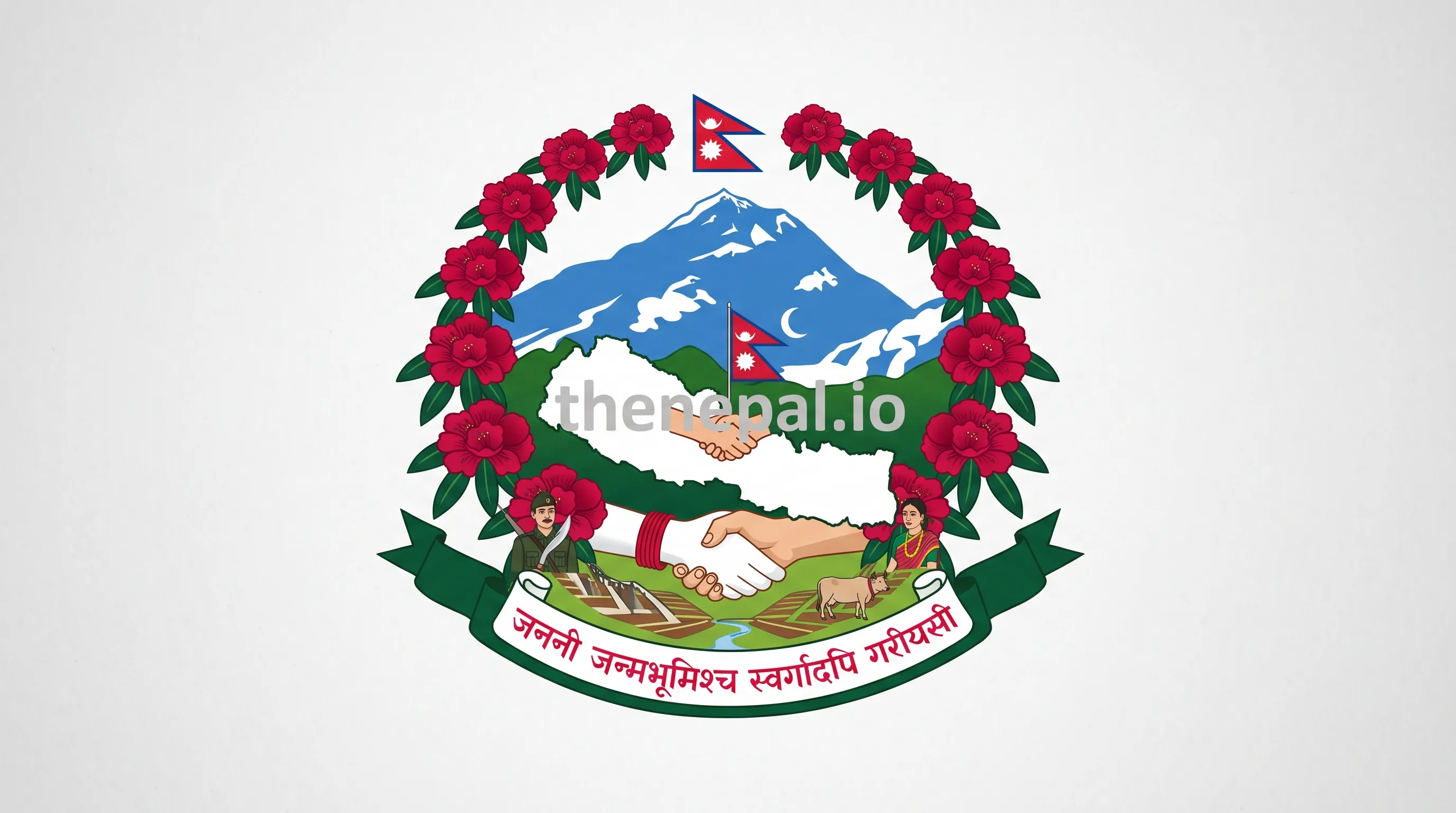
Nepal's national emblem packs the country's geography, values and history into a single coat of arms. From the snow-capped triangle of Mount Everest at its peak to the small red scroll at its base, every element was chosen to say something specific about the nation — and, unusually among Nepal's national symbols, the emblem's meaning and adoption date are a matter of official record rather than popular convention.
What Each Element Means
Reading from top to bottom, the emblem layers Nepal's landscape, people and principles into one design. Hover or tap each card below for its meaning.
Geography and people
Mount Everest crowns the design, representing national pride and the Himalaya. Green hills below stand for Nepal's middle hill region, and a yellow band represents the fertile Terai plains to the south.
A man's and a woman's hands clasp together at the centre, symbolising gender equality, encircled by a garland of rhododendron — Nepal's national flower — standing for the country's natural beauty and diversity.
Framing the whole design is a white silhouette in the shape of Nepal itself, with the national flag seated at the very top and, at the base, a red scroll carrying the national motto in Sanskrit: जननी जन्मभूमिश्च स्वर्गादपी गरीयसी (Jananī Janmabhūmiśca svargādapi garīyasī) — "Mother and Motherland are greater than Heaven," a line drawn from the Ramayana, spoken by Rama when his brother Lakshmana expresses a wish to remain in Lanka.
Source: Wikipedia (Emblem of Nepal); heraldry-wiki.com
At a glance
From Royal Arms to Republican Emblem
Today's emblem is a relatively recent design, replacing a much older royal coat of arms that had represented the Kingdom of Nepal for roughly a century. That earlier achievement, dating to around the turn of the 20th century under King Prithvi Bir Bikram Shah Dev, carried a white cow, a green pheasant, two Gurkha soldiers armed with a khukuri and a rifle, Himalayan peaks, crossed flags and khukuris, the footprints of Gorakhnath — the guardian deity of the Gurkhas — and the royal crown. From 1935 to 1962 it even carried a second, Latin motto: Dulce et decorum est pro patria mori ("How sweet and honourable it is to die for the fatherland"). A revised 1962 version placed a white zebu, a sitting Himalayan monal, a temple, and the Himalayas around a scroll of rhododendron branches.
Everything changed after Nepal's civil war. As part of the political reconciliation that followed, the Cabinet introduced an entirely new, non-royal emblem on 30 December 2006, designed by a commission led by Narendra Raj Rajbhandari. That design — Everest, hills, Terai, joined hands and rhododendron, with no crown, soldiers or royal cypher — was formally adopted as Nepal's official emblem on 28 May 2008, the same day the monarchy was abolished and the republic declared. In 2020, the emblem's map silhouette was updated to reflect Nepal's revised political boundaries, incorporating Kalapani, Lipulekh Pass and Limpiyadhura as claimed Nepali territory, with the new version taking effect on 13 June 2020.
✦ Did you know?
- The old royal Latin motto — "sweet and honourable to die for the fatherland" — comes from the Roman poet Horace's Odes, not from any Nepali source.
- The 2020 map revision was made in response to a territorial dispute with India over the Kalapani-Lipulekh-Limpiyadhura area.
- Nepal's crimson national colour appears in three places at once: the flag, the emblem's scroll, and the rhododendron garland itself.
Source: Wikipedia (Emblem of Nepal); heraldry-wiki.com
Emblem Timeline
Old Arms vs. New Emblem
| Feature | Royal arms (pre-2006) | Republican emblem (2008–) |
|---|---|---|
| Central figures | Cow, pheasant, Gurkha soldiers, Himalayan peaks | Mount Everest, green hills, yellow Terai |
| Crown | Royal Nepalese crown | None |
| Human figures | Two soldier supporters | Joined man's and woman's hands |
| Border motif | Crossed flags and khukuris | Rhododendron garland |
| Motto | Sanskrit motto, plus Latin motto (1935–1962) | Sanskrit motto only |
| Adopted | ~1900s, revised 1962 | 2006/2008, revised 2020 |
Source: heraldry-wiki.com; Wikipedia (Emblem of Nepal)
Frequently Asked Questions
What is the national emblem of Nepal?
The national emblem of Nepal is the official coat of arms of the Government of Nepal, featuring Mount Everest, green hills, the yellow Terai plains, joined hands symbolising gender equality, a rhododendron garland, a white map silhouette of Nepal, the national flag, and a scroll bearing the national motto in Sanskrit.
When was the national emblem of Nepal adopted?
The current design was introduced on 30 December 2006 and formally adopted as the official emblem on 28 May 2008, the same day Nepal's monarchy was abolished and the republic was declared. It was last revised on 13 June 2020 to update the political map.
What does the national motto on the emblem mean?
The motto, जननी जन्मभूमिश्च स्वर्गादपी गरीयसी (Jananī Janmabhūmiśca svargādapi garīyasī), translates as "Mother and Motherland are greater than Heaven." It's a line from the Ramayana, spoken by Rama when his brother Lakshmana wishes to remain in Lanka.
Why does the emblem show Mount Everest?
Mount Everest, known in Nepal as Sagarmatha, represents national pride, endurance, and Nepal's identity as home to the world's highest peak — the same reasoning that makes it Nepal's closest thing to a national mountain.
What did Nepal's emblem look like before 2006?
Nepal's earlier royal coat of arms featured a white cow, a green pheasant, two Gurkha soldiers, Himalayan peaks, crossed flags and khukuris, the footprints of the deity Gorakhnath, and the royal Nepalese crown — symbols tied to the monarchy rather than the republic.
Who designed the current emblem of Nepal?
The current emblem was designed by a government commission led by Narendra Raj Rajbhandari and introduced by the Cabinet on 30 December 2006.
Is Nepal's national emblem a coat of arms?
Yes. It is officially described as Nepal's coat of arms and functions as the Government of Nepal's emblem on official documents and seals.
Why was Nepal's emblem changed?
The emblem was redesigned as part of the political reconciliation following Nepal's civil war, removing royal symbols such as the crown ahead of the monarchy's abolition and the declaration of the republic in 2008.
What flower appears on the emblem of Nepal?
The rhododendron, known locally as laliguras and recognised as Nepal's national flower, appears as a garland around the emblem.
What language is the motto written in?
The motto is written in Sanskrit: जननी जन्मभूमिश्च स्वर्गादपी गरीयसी (Jananī Janmabhūmiśca svargādapi garīyasī).
What does the joined hands symbol represent?
The joined hands of a man and a woman at the centre of the emblem represent gender equality.
What changed in the 2020 revision?
The 2020 revision updated the white map silhouette to include Kalapani, Lipulekh Pass and Limpiyadhura as claimed Nepali territory, following a territorial dispute with India.
Does Nepal have a royal emblem today?
No. The royal coat of arms, which included the crown and Gurkha soldier supporters, was retired when the current republican emblem was formally adopted on 28 May 2008, the day the monarchy was abolished.
Where is Nepal's national emblem used?
The emblem appears on official government documents, seals, passports, currency, and government buildings as the formal coat of arms of the Government of Nepal.
