
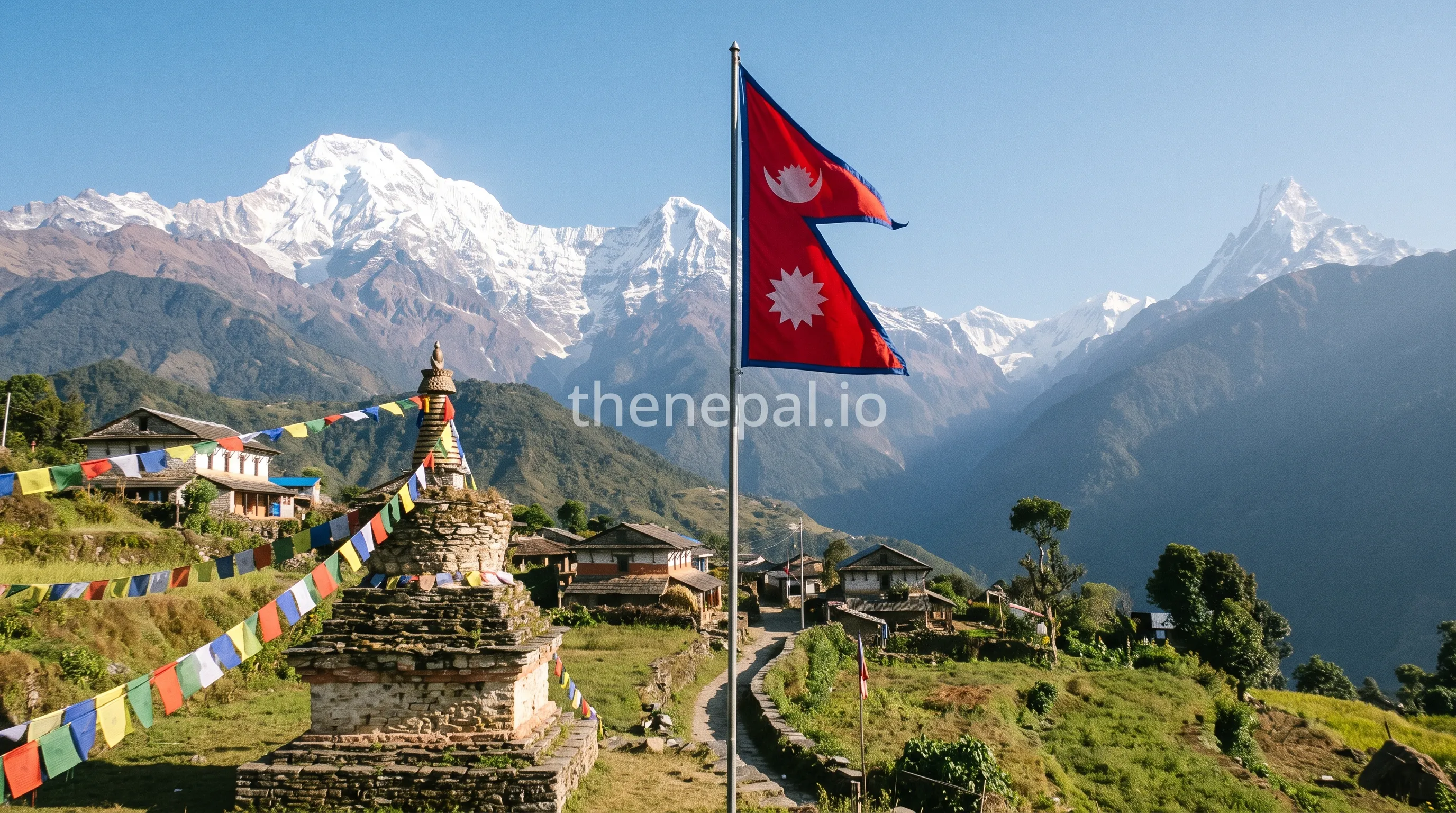
Long before it was formalised as a national symbol, crimson red was already everywhere in Nepal — on the red war banner of the Shah kings of Gorkha and on the vermilion tika pressed onto foreheads during festivals. It's one of the few national symbols that isn't tied to a single object, but to a colour that runs through nearly everything else Nepal considers its own.
Where the Colour Comes From: The Flag
Legal basis: Constitution of Nepal 2015, Article 9(3), which states that crimson is the national color. Text on Constitute Project.
Nepal's national colour is inseparable from its national flag. The current flag — the world's only non-rectangular national flag — was standardised on 16 December 1962, with a crimson red field bordered in deep blue. According to the flag's official symbolism, the crimson represents the bravery of the Nepali people, while the blue border represents peace and harmony.
Schedule 1 of Nepal's constitution sets out a specific method of constructing the flag; we found no official hex or Pantone value for its colours. The shades shown here are the ones most commonly used to reproduce the flag digitally, not a legally fixed standard.
Source: Constitution of Nepal, Schedule 1; Wikipedia, Flag of Nepal
Why Crimson: The Meaning Behind the Colour
Crimson red stands for bravery. The flag of the Gorkha kingdom began as a single triangular red war banner of the Shah kings, and after Prithvi Narayan Shah unified the principalities in the 18th century the double-pennon became the standard flag, inspired by Hindu dhvaja religious banners.
Crimson is also the colour of Nepal's national flower, the rhododendron (Lali Gurans), which blooms in shades of red — which is why the flag, the flower and the national colour are so often described together.
Source: Wikipedia, Flag of Nepal
Where You'll See Crimson Red in Nepali Life
Crimson isn't confined to flagpoles — it's woven through daily and ceremonial life across Nepal.
Crimson across Nepali culture
| Occasion | How crimson appears |
|---|---|
| Dashain | Red tika applied to the forehead as a blessing |
| Tihar / Bhai Tika | Tika and garlands exchanged between siblings |
| Weddings | Red bridal sari; sindoor applied along the hair parting |
| Teej | Red saris worn widely by married women |
✦ Did you know?
- Nepal's flag is the only national flag in the world that isn't rectangular — and crimson is its dominant colour.
- The flag and Nepal's national flower, the rhododendron, are both linked to red.
- Sindoor, the red powder worn by married Hindu women in Nepal, is considered one of the most visible everyday uses of the national colour.
Frequently Asked Questions
What is the national colour of Nepal?
Crimson red is the national colour of Nepal. It is the dominant colour of the national flag, adopted in its current form on 16 December 1962.
What does crimson red symbolise in Nepal?
Crimson red symbolises bravery. It is also the colour of Nepal's national flower, the rhododendron.
Why is red used so often in Nepali festivals?
Red is considered an auspicious colour in Nepali Hindu culture, used in tika, sindoor, wedding attire and festival decorations during occasions like Dashain, Tihar and Teej.
Is there an official hex code for Nepal's national colour?
Nepal's constitution sets out how to construct the flag, but we found no official hex or Pantone colour code. The shade commonly used to reproduce the flag online is close to crimson, hex #DC143C.
What colour is the border of Nepal's flag?
The flag's border is deep blue, commonly reproduced as hex #003893, symbolising peace and harmony, in contrast with the crimson red field.
When was the flag carrying Nepal's national colour adopted?
The current national flag, whose field is crimson red, was adopted on 16 December 1962.
Which national symbols use crimson red?
Crimson red appears on the national flag and the national flower, and in the tika and sindoor.