Nepal's flag is not drawn from a simple width-to-height ratio. Schedule 1 of the Constitution of Nepal gives a method of 24 numbered steps, built from straight lines, arcs and circles. This page explains how that method is organised. It does not replace the legal text.
The 24 Steps in Four Parts
| Part | Steps | What it draws |
|---|---|---|
| 1. The shape | 1–5 | A base line AB on crimson cloth, a perpendicular AC, and the points that give the two-pennant outline |
| 2. The moon | 6–18 | Semicircles and arcs that fix the crescent, with eight equal triangles inside it |
| 3. The sun | 19–22 | Two circles, with twelve equal triangles in the ring between them |
| 4. The border | 23–24 | A deep blue border on all sides, whose width equals the segment TN |
Source: Constitution of Nepal 2015, Schedule 1 (relating to Article 8), as reproduced on Constitute Project and the Nepal Law Commission's published text.
Part 1: The Shape
The method starts on the lower part of a crimson cloth with a base line AB drawn from left to right. A perpendicular AC is then raised from A. Its length is the length of AB plus one third of AB, so the flag is taller than it is wide. Further points on these lines are joined to give the outline of two stacked triangles, the shape often called two pennants.
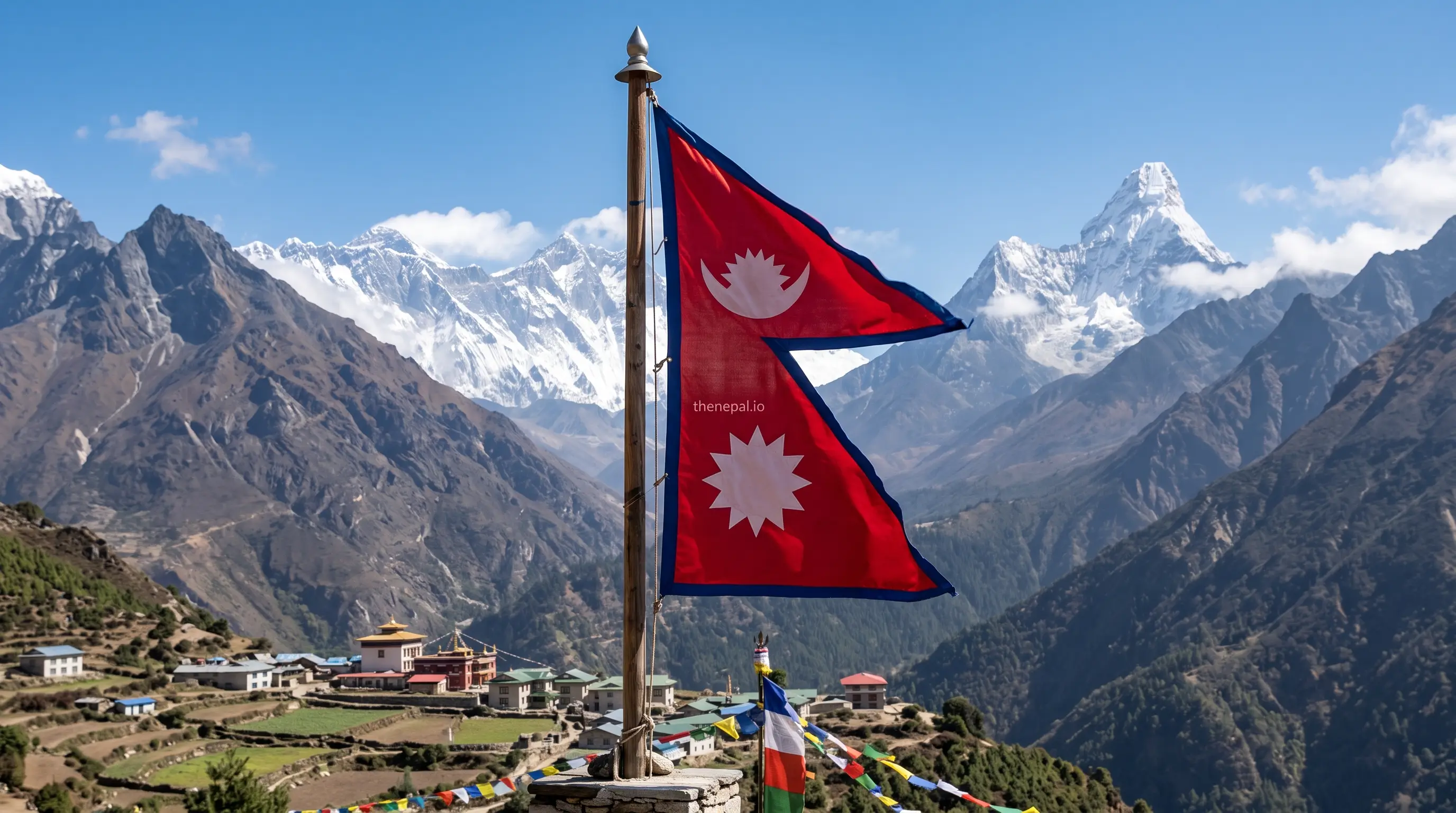
Nepal's flag is the only national flag in the world that is not a rectangle or square. Schedule 1 is what keeps its outline identical wherever it is made.
Parts 2 and 3: The Moon and the Sun
The crescent moon takes the longest part of the method, 13 of the 24 steps. Points are marked from measured distances and crossing lines, and semicircles and arcs are drawn from them. The crescent lies between one semicircle and one arc, and eight equal and similar triangles are made in it.
The sun is drawn lower down. A line is bisected, two circles are drawn from the same centre, and twelve equal triangles fill the ring between them. Each pair of apexes touches a construction line. The moon and sun are white and the field is crimson.
Part 4: The Border
The border is deep blue and runs along every side of the flag. Its width equals the length TN from the construction. The outer corners repeat the angles of the inner ones. For a flag hung from a pole rather than a rope, Schedule 1 allows the border along the hoist side to be extended to make a sleeve.
Lines You Never See
Many of the lines and arcs in the method are imaginary guides. They exist only to place points and do not appear on the finished flag, apart from the edge of the crescent moon. The size of the flag is not fixed in Schedule 1. It is left to the Government of Nepal to decide.
Why It Is Written in the Constitution
The flag was adopted on 16 December 1962 with the constitution of that year. Writing the full construction into the constitution means any maker can reproduce the same flag from the text alone. Today the flag is named in Article 8 and its drawing method is in Schedule 1 of the 2015 Constitution. The colours and meaning are covered on the National Flag and National Colour pages.
Frequently Asked Questions
How many steps are in the construction of Nepal's flag?
Schedule 1 of the Constitution of Nepal gives 24 numbered steps, grouped as the shape (steps 1–5), the moon (6–18), the sun (19–22) and the border (23–24).
Why is Nepal's flag not a rectangle?
Its outline is two stacked triangular pennants. It is the only national flag in the world that is neither a rectangle nor a square, and Schedule 1 fixes the exact shape.
How many rays do the sun and moon have?
The moon has eight equal triangles and the sun has twelve, as set by Schedule 1.
What colour and width is the border?
Deep blue, running on all sides. Its width equals the segment called TN in the construction.
Where can I read the exact measurements?
In Schedule 1 of the Constitution of Nepal 2015, available on Constitute Project and from the Nepal Law Commission. This page only explains the structure.