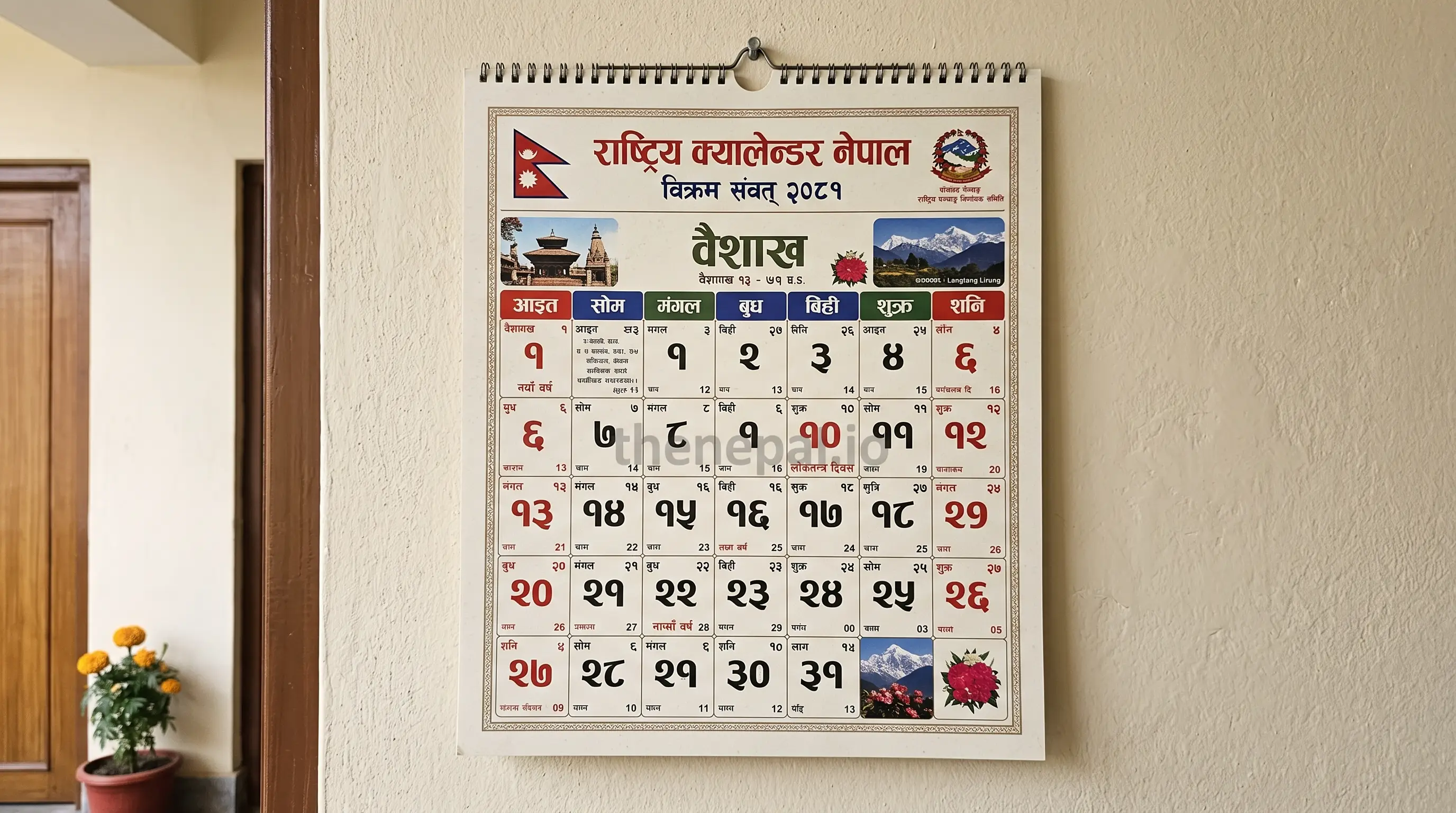
Open any Nepali newspaper and the date at the top will look unfamiliar to most visitors — not because the day or month is off, but because the year itself runs decades ahead of the Gregorian calendar. That's Bikram Sambat, Nepal's official calendar, and once you understand the offset, the rest of the system falls into place quickly.
Why the Year Number Looks So Different
Bikram Sambat runs roughly 56 years and 8 months ahead of the Gregorian calendar, because its epoch is traditionally dated to 57 BCE rather than the year 1 CE used by the Gregorian system. In practice, this means the Bikram Sambat year 2083 corresponds to 2026 in the Gregorian calendar — and because the Nepali New Year falls in mid-April rather than January, the exact offset shifts by one year partway through each Gregorian calendar year.
The offset, at a glance
Roughly 56 years and 8 months separate the two systems — the exact difference depends on which month of the Nepali year it currently is.
Where the Calendar Comes From
Tradition credits Bikram Sambat to King Vikramaditya of Ujjain, who is said to have established the era after a military victory around 57 BCE. The calendar spread across the Indian subcontinent over the following centuries and reached Nepal through the historical ties between Vikramaditya's line and Nepal's own Lichchhavi kings — some historians even argue the calendar may have originated with the Lichchhavi ruler Mandev rather than in India at all, though this remains debated.
Bikram Sambat's path to becoming Nepal's official calendar wasn't immediate. After the Gorkha conquest of the Kathmandu Valley in 1769, the long-standing Nepal Sambat calendar was replaced first by the Shaka Sambat era, which remained in official use for well over a century. It was only in 1901 CE, during the Rana period, that Bikram Sambat was formally adopted as Nepal's official calendar, a status it has held ever since.
Source: Wikipedia, Vikram Samvat; Nepal Sambat historical records
Not the Only National Calendar
Bikram Sambat isn't Nepal's only calendar with official recognition. Nepal Sambat, the lunisolar calendar of the Newar people, dates back to 20 October 879 AD and was the Kathmandu Valley's official calendar for nearly nine centuries until the end of the Malla dynasty. After a long cultural revival movement, the government recognised Nepal Sambat as a national calendar in 2011, and since November 2023 it has also been included in official government documents alongside Bikram Sambat.
Two calendars, two roles
Used for government business, official documents, holidays and everyday civil dates nationwide.
Newar lunisolar calendar; central to Newar festivals and increasingly included alongside Bikram Sambat in official use.
Source: Wikipedia, Nepal Sambat
Structure of the Bikram Sambat Year
The Bikram Sambat year has 12 months, beginning with Baisakh and ending with Chaitra. Unlike the fixed 30- or 31-day months of the Gregorian calendar, Bikram Sambat months vary in length from about 29 to 32 days, since the calendar reconciles both solar positioning and lunar phases.
| Month | Approx. Gregorian overlap |
|---|---|
| Baisakh | mid-April – mid-May |
| Jestha | mid-May – mid-June |
| Ashadh | mid-June – mid-July |
| Shrawan | mid-July – mid-August |
| Bhadra | mid-August – mid-September |
| Ashwin | mid-September – mid-October |
| Kartik | mid-October – mid-November |
| Mangsir | mid-November – mid-December |
| Poush | mid-December – mid-January |
| Magh | mid-January – mid-February |
| Falgun | mid-February – mid-March |
| Chaitra | mid-March – mid-April |
✦ Did you know?
- Bikram Sambat's structure closely resembles the Bengali calendar, sharing the same month names and start dates.
- Major festivals like Dashain, Tihar and Maghe Sankranti are all scheduled according to the Bikram Sambat calendar.
- Nepal is one of the very few countries in the world where the Gregorian calendar is not the primary civil calendar.
Frequently Asked Questions
What is the national calendar of Nepal?
Bikram Sambat, a lunisolar calendar abbreviated B.S., is Nepal's official calendar. It is used for government records, official documents, newspapers and everyday civil life.
How far ahead is Bikram Sambat from the Gregorian calendar?
Bikram Sambat runs approximately 56 years and 8 months ahead of the Gregorian calendar. For example, the Bikram Sambat year 2083 corresponds to 2026 in the Gregorian calendar.
When does the Nepali New Year start?
The Nepali New Year begins on the first day of Baisakh, which usually falls around 13 to 15 April in the Gregorian calendar, and is a public holiday in Nepal.
Is Nepal Sambat also a national calendar?
Yes. Nepal Sambat, the lunisolar calendar of the Newar people dating to 879 AD, was recognised as a national calendar alongside Bikram Sambat in 2011, and the government began including it in official documents alongside Bikram Sambat from November 2023.
How many days are in a Bikram Sambat month?
Bikram Sambat months vary in length from about 29 to 32 days, unlike the fixed lengths of Gregorian calendar months, because the calendar combines solar and lunar calculations.