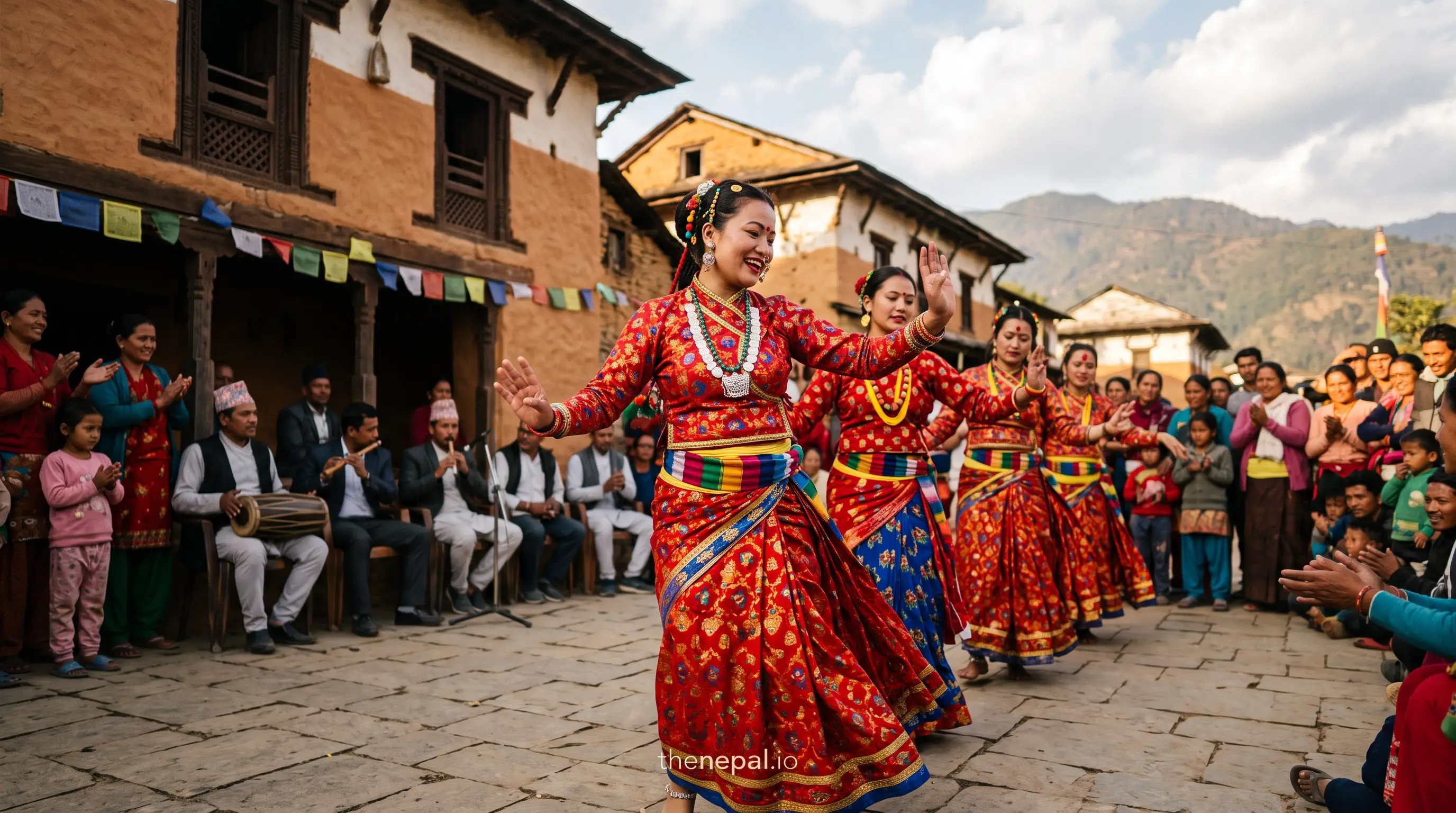
When people ask what Nepal's national dance is, two names come up again and again: Deuda and Maruni. Deuda is the great participatory dance of the far west — a circle of linked hands and call-and-response song performed at festivals like Gaura Parva. Maruni is the great performance dance of the mid-hills — a costumed, drum-driven tradition rooted in the Magar community and closely tied to Dashain and Tihar. Between them, they capture the two poles of Nepali dance: everyone dancing together, and dancers performing for everyone else.
Two Dances, Two Traditions
Deuda and Maruni earn their place as Nepal's national dances for different reasons — one for how widely ordinary people take part in it, the other for how far its performance tradition has travelled.
Nepal's two national dances
Performed across Karnali and Sudurpaschim provinces, Deuda gathers a whole community into a circle, hands or fingers linked, moving and singing dohori-style verses together. It is less a performance than a shared ritual of belonging.
Originating with the Magar community, Maruni is danced by costumed performers — traditionally men in colourful female dress — to the nine-instrument naumati baja orchestra. It has spread from western Nepal to communities across the country and into the diaspora.
Beyond these two, dozens of other forms carry deep meaning for their own communities — Sakela among the Rai and Limbu, Ghatu among the Gurung, the Lakhey Naach among Kathmandu's Newars — each central to its own community's identity.
Source: Wikipedia (Dance in Nepal, Maruni); Native Nepali Stage; ImNepal.com
Where Nepali Dance Comes From
Legend traces Nepali dance to the Himalayas themselves — the abode of Lord Shiva, who is said to have performed the tandava there, giving dance in Nepal an ancient, almost geological origin story. From that root, the tradition split along ethnic and regional lines: Nepal's more than 100 ethnic groups and 124 mother tongues each developed distinct dance forms, shaped by local costume, instrumentation, and the festivals that call for them.
Scholars generally sort these into two broad families. Classical dances, like the centuries-old Kartik Naach of Patan or the sacred Charya Nritya of Newar Buddhist priests, follow long-established technique passed down through formal lineages. Folk dances, the much larger category — including both Deuda and Maruni — are tied to specific communities, harvests, and festivals, performed by ordinary people rather than trained specialists, and changing gently from village to village.
Deuda: Nepal's Dance of Unity
Deuda belongs to the Khas communities of Nepal's far west and is performed above all during Gaura Parva, a festival honouring Goddess Gaura. Participants form a circle, link hands or hook fingers, and step in rhythm while singing Deuda geet — verses that move through love, folklore, and daily life in a call-and-response pattern between men and women. Unlike costumed performance dances, Deuda needs no stage, no trained performers, and no audience: everyone present is expected to join in, which is precisely the point — the dance is built to fold a whole community into one shared movement.
Deuda has travelled with far-western migrants into Kathmandu, where displaced communities now gather at open spaces like Tundikhel to perform it during festival season, keeping the tradition alive far from its home provinces.
Maruni: Nepal's Dance of Celebration
Maruni traces back to the Magar community and, by tradition, to the 14th-century court of a sick King Balihang Rana Magar of Palpa. Performers, both men and women, dress in vivid costume and ornaments and dance to the nine-instrument naumati baja ensemble, often shadowed by a clownish figure called the dhatu waray. Long associated with Dashain and Tihar, Maruni is now performed at weddings and cultural events too, and has spread with Nepali communities into Bhutan, Sikkim, Darjeeling and Assam.
✦ Did you know?
- In Maruni's older tradition, male dancers played the female roles entirely — a convention now more often replaced by women performers.
- Deuda is danced without musical instruments in its purest form — the rhythm comes entirely from the singers' own voices.
- Both dances face a real risk of fading as fewer young performers take them up, which has pushed some communities to actively teach them to the next generation.
Source: Wikipedia (Maruni); ImNepal.com; Native Nepali Stage
Notable Dances Across Nepal
With well over 70 documented dance forms, no single table can cover Nepal's dance heritage — but a handful recur again and again in any serious account of it, alongside Deuda and Maruni.
| Dance | Community / Region | Known for |
|---|---|---|
| Deuda | Karnali & Sudurpaschim provinces | Circular unity dance, no instruments needed |
| Maruni | Magar, Gurung, Kirati — nationwide | Nepal's best-known costumed folk dance |
| Lakhey Naach | Newar — Kathmandu Valley | Masked demon dance at Indra Jatra |
| Sakela Naach | Rai, Limbu — eastern Nepal | Longest group dance, honours nature deities |
| Ghatu Nritya | Gurung — western Nepal | Classical trance dance by young unmarried girls |
| Charya Nritya | Newar Buddhist priests — Kathmandu, Lalitpur | Sacred classical temple dance |
| Tamang Selo / Damphu | Tamang — central hills | Fast-paced dance with the damphu hand drum |
Source: Wikipedia (Dance in Nepal); OnlineKhabar; Kathmandu Post
Frequently Asked Questions
What is the national dance of Nepal?
Deuda and Maruni are widely regarded as Nepal's national dances. Deuda is the circular, hand-linked unity dance of the far west, and Maruni is the Magar community's costumed festival dance associated with Dashain and Tihar. Worth noting: this rests on popular recognition rather than a formal constitutional designation, unlike Nepal's official national flower, bird, or animal.
What is Deuda dance?
Deuda is a participatory folk dance from Nepal's far-western Karnali and Sudurpaschim provinces. Performers form a circle, link hands, and sing call-and-response verses called Deuda geet, most prominently during the Gaura Parva festival. It requires no instruments and no trained performers — the whole community is meant to join in.
What is Maruni dance?
Maruni is a folk dance originating with the Magar community, traditionally performed during Dashain and Tihar and accompanied by the nine-instrument naumati baja orchestra. It is one of Nepal's oldest and most widely performed dances, also found among Nepali diaspora communities in India, Bhutan and Myanmar.
What is the Lakhey Naach?
The Lakhey Naach is a masked dance performed by the Newar community of Kathmandu during the Indra Jatra festival, featuring a fierce, red-maned demon figure believed to protect children. It's one of Nepal's most recognisable cultural images.
How many traditional dances does Nepal have?
Estimates vary, but researchers and cultural archives have documented well over 70 distinct traditional dance forms across Nepal's many ethnic communities, spanning classical, folk and ritual traditions.
What are the two main types of Nepali dance?
Nepali dance is broadly divided into classical dance, based on long-established technique passed through formal lineages, and folk dance, tied to specific communities, festivals and regions and performed by ordinary people rather than trained specialists.