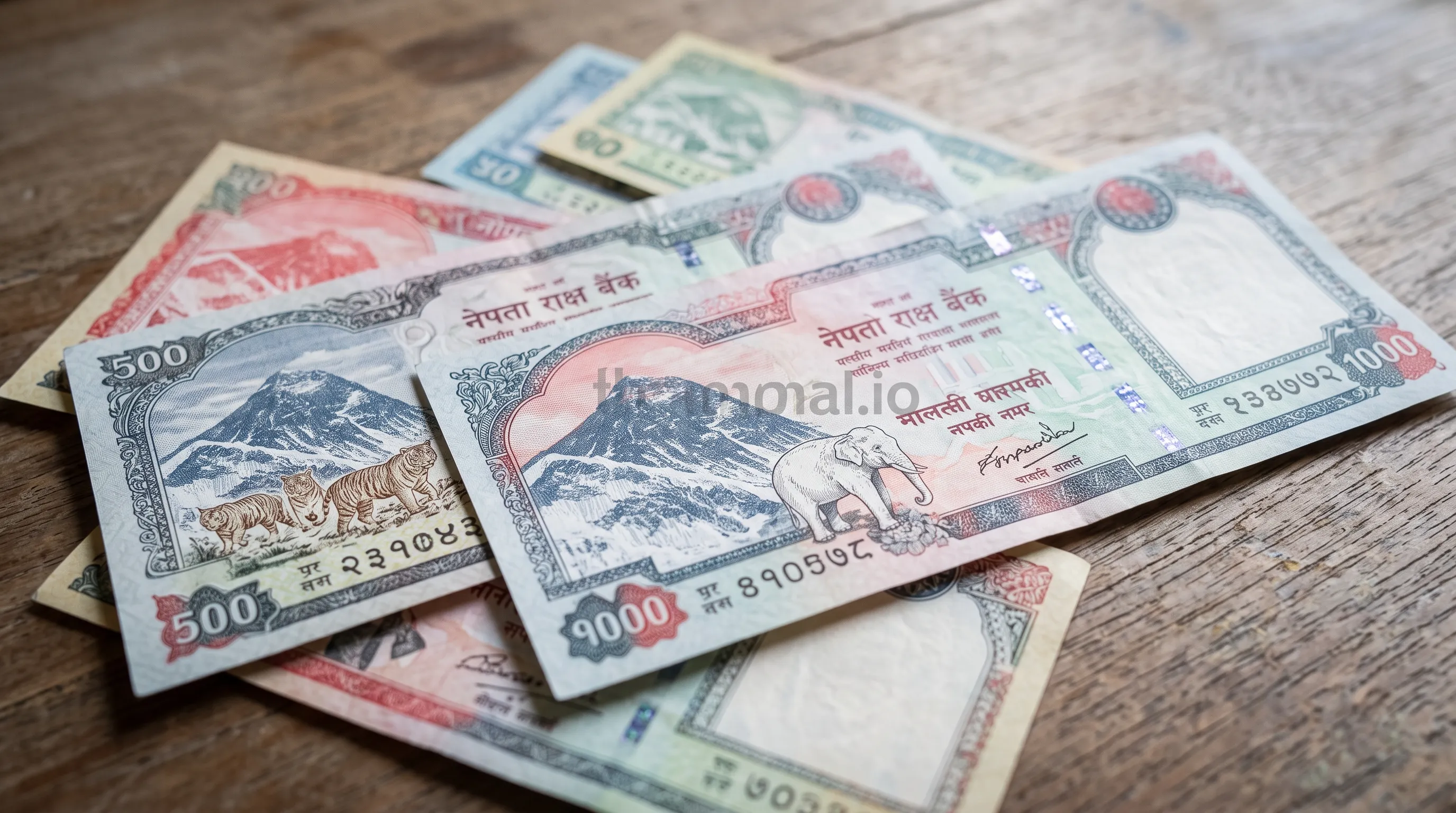
Ask what Nepal's currency is, and most people will simply say "rupees" — and they wouldn't be wrong. But the story behind the Nepalese Rupee is a little more layered: it's a currency managed entirely by Nepal's own central bank, yet tied by a fixed exchange rate to its much larger neighbour, India, in a relationship that dates back over three decades.
Issuance and the Indian Peg
Nepal Rastra Bank, established in 1956, is the sole authority responsible for issuing banknotes and coins and for setting monetary policy in Nepal. Unlike most central banks, however, Nepal Rastra Bank does not set interest rates or currency value entirely independently — because the Nepalese Rupee has been pegged to the Indian Rupee at a fixed rate since 1993.
Two currencies, one fixed rate
Legal tender across Nepal, issued by Nepal Rastra Bank in banknotes and coins.
A fixed exchange rate maintained since 1993, meaning 1 Indian Rupee equals 1.6 Nepalese Rupees.
This peg keeps the two currencies moving in lockstep and, in practice, means Indian Rupee notes up to a certain denomination circulate informally alongside Nepalese Rupees in many border areas — though Indian notes above Rs 100 are officially restricted in Nepal.
Source: Nepal Rastra Bank
How the Rupee Came to Be
Before a unified national currency existed, the territory that is now Nepal used a patchwork of local coinages, including the Mohar, minted by various regional rulers and princely mints. As the modern Nepali state consolidated, the government moved steadily toward a single standardised currency, and by the early-to-mid 20th century the rupee had become the dominant unit of account nationwide, eventually replacing older coinages entirely.
Nepal Rastra Bank's founding in 1956 marked the turning point for modern currency management, centralising note issuance under one institution and setting the stage for the decimal system in use today, where 1 rupee divides into 100 paisa.
Symbol, Denominations and Everyday Use
The Nepalese Rupee is commonly abbreviated as Rs or NPR, and written in Devanagari as रू, which distinguishes it from the near-identical Indian Rupee symbol ₹. Coins are issued in smaller denominations for everyday transactions, while banknotes carry portraits, national landmarks and Nepal's coat of arms, alongside security features such as watermarks and security threads.
Cash remains widely used across Nepal, though digital payment platforms and mobile wallets have grown quickly in urban centres, running alongside — rather than replacing — traditional rupee notes and coins.
✦ Did you know?
- Nepal issued a commemorative Rs 250 banknote to mark the 250th anniversary of national unification.
- Nepal Rastra Bank introduced polymer versions of the Rs 10 and Rs 20 notes to improve durability.
- Indian currency notes above Rs 100 are not accepted as legal tender in Nepal, despite the fixed exchange peg between the two currencies.
Common Banknote Denominations
Nepal Rastra Bank issues banknotes across a standard range of denominations, each featuring distinct imagery of Nepal's landmarks, culture and natural heritage.
| Denomination | Typical material |
|---|---|
| Rs 5 | Paper |
| Rs 10 | Polymer |
| Rs 20 | Polymer |
| Rs 50 | Paper |
| Rs 100 | Paper |
| Rs 500 | Paper |
| Rs 1000 | Paper |
Source: Nepal Rastra Bank
Frequently Asked Questions
What is the national currency of Nepal?
The Nepalese Rupee, abbreviated NPR and symbolised as रू or Rs, is Nepal's official currency. It is issued and regulated by Nepal Rastra Bank, the country's central bank.
Is the Nepalese Rupee pegged to another currency?
Yes. The Nepalese Rupee has been pegged to the Indian Rupee since 1993 at a fixed rate of 160 Nepalese Rupees to 100 Indian Rupees, meaning 1 Indian Rupee equals 1.6 Nepalese Rupees.
Who issues currency in Nepal?
Nepal Rastra Bank, established in 1956, is the sole authority responsible for issuing banknotes and coins and regulating monetary policy in Nepal.
What denominations of Nepalese currency exist?
Nepalese Rupee banknotes are commonly issued in denominations of 5, 10, 20, 50, 100, 500 and 1000 rupees, alongside coins in smaller denominations, with occasional commemorative notes issued for special anniversaries.
What symbol is used for the Nepalese Rupee?
The Nepalese Rupee is commonly abbreviated as Rs or NPR, and written in Devanagari as रू, distinguishing it from the Indian Rupee symbol ₹.