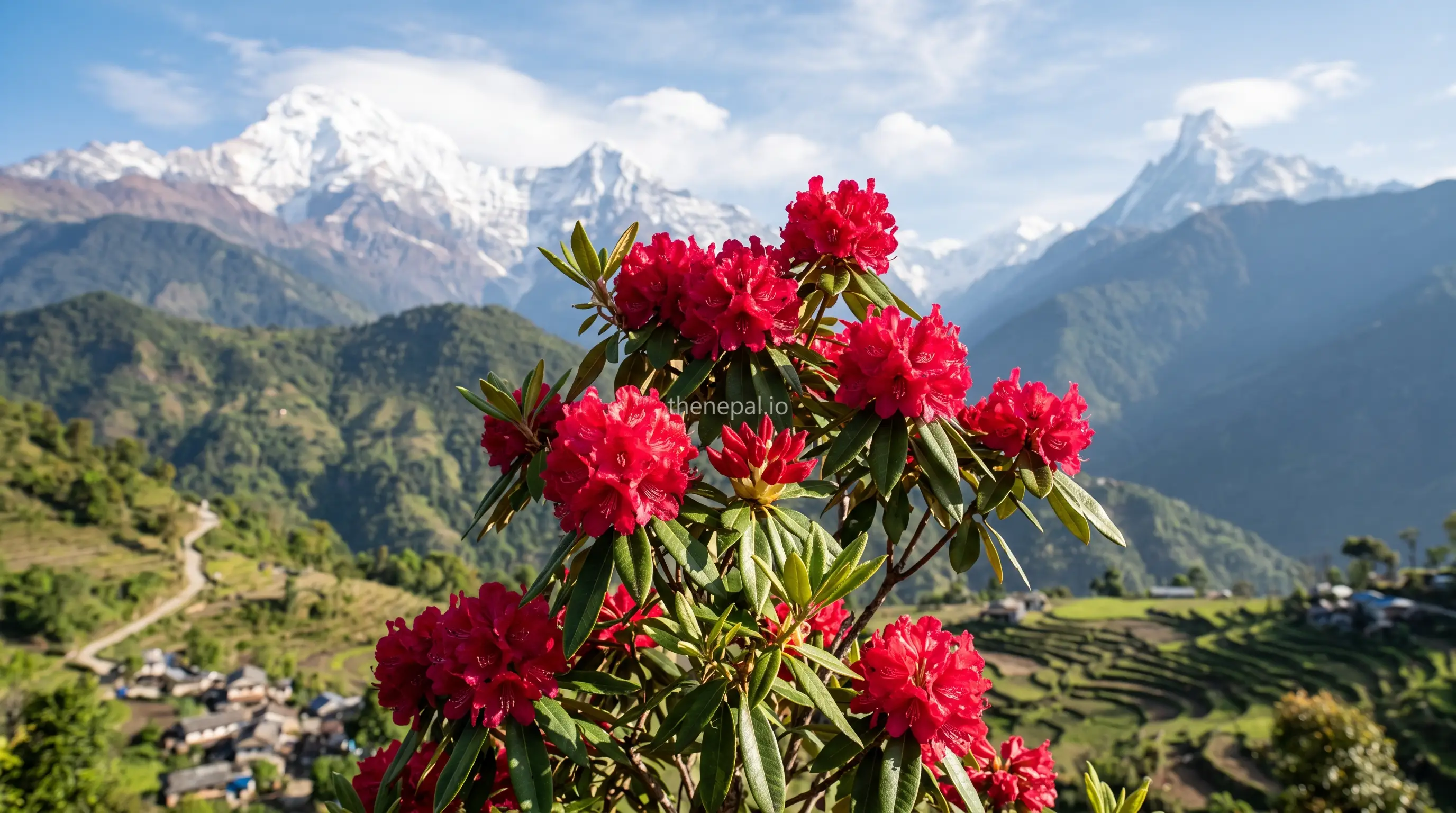
Ask a Nepali hiker what colour spring is, and most will say red. From roughly 1,200 metres up to the tree line, forests of Rhododendron arboreum burst into bloom each year, turning entire ridgelines into bands of crimson, rose and white. It's this scale and intensity — not rarity — that earned Lali Gurans its place as Nepal's national flower.
Why the Rhododendron Became Nepal's National Flower
Nepal formally adopted the rhododendron as its national flower in 1962, alongside the cow as national animal and the Himalayan Monal as national bird, as part of a broader effort to codify natural symbols that represented the country's geography and identity. Rhododendron was a natural choice: it grows across the hills and lower mountains that most Nepalis actually live among, unlike symbols tied only to the high Himalaya.
Where many "national flowers" are chosen for rarity or royal association, Lali Gurans was chosen for the opposite reason — its abundance. It is the plant most Nepalis have grown up walking beneath, picking, and using, which is part of why it still resonates as a shared symbol rather than a distant emblem.
Source: Department of Forests and Soil Conservation, Government of Nepal
How Elevation Changes the Colour
One of the more striking facts about Nepal's rhododendrons is that colour and form shift with altitude. Lower-elevation forests tend to produce the deepest crimson-red blooms, while trees higher up the slope shade toward pink, rose and eventually white or pale purple as conditions get colder and harsher.
Bloom colour across elevation bands
This banding is one reason trekking routes that climb steadily — like Ghorepani–Poon Hill in the Annapurna region — are famous for rhododendron viewing: a single day's walk can pass through several colour zones at once.
Species Found in Nepal
Nepal is home to a notably high diversity of rhododendron species for its size, spread across temperate and subalpine forest zones. A few of the most recognisable:
| Species | Common colour | Typical elevation |
|---|---|---|
| Rhododendron arboreum | Crimson red | 1,200–2,400 m |
| Rhododendron campanulatum | Lavender / pale purple | 3,000–3,600 m |
| Rhododendron barbatum | Deep red | 2,400–3,200 m |
| Rhododendron campylocarpum | Yellow | 3,000–3,700 m |
| Rhododendron lepidotum | Pink to purple, dwarf shrub | 3,000–4,600 m |
Rhododendron arboreum, the crimson lowland species, is specifically the one recognised as the national flower.
Source: Department of Plant Resources, Government of Nepal
✦ Did you know?
- Nepal has over 30 recorded species of rhododendron, more than almost any country its size.
- Not every species blooms red — some, like Rhododendron campylocarpum, flower bright yellow.
- Gurans juice, made from the crimson petals, is a popular seasonal drink in Himalayan hill villages.
Culture, Uses and Everyday Life
Culinary and traditional uses
The fresh red petals of Rhododendron arboreum are used across the hills to make a tart, ruby-coloured juice and jam, often sold seasonally along trekking routes. The petals are also pickled or used in traditional recipes in some communities.
Symbolism
Lali Gurans appears widely in Nepali folk songs and poetry as a symbol of youth, beauty and the arrival of spring. It's also used informally as a symbol of national pride, appearing in event branding, tourism campaigns and provincial imagery — Rhododendron arboreum was additionally named the state flower of the Indian states of Uttarakhand and Himachal Pradesh, reflecting its wider presence across the Himalayan belt.
Where to see it
- Annapurna region — Ghorepani–Poon Hill is Nepal's best-known rhododendron trail.
- Langtang National Park — dense rhododendron forest along the lower trail sections.
- Gosaikunda trek — passes through several elevation bands of bloom.
- Kanchenjunga Conservation Area — high species diversity, including rarer alpine varieties.
- Rara National Park — remote, less-visited rhododendron forest in far-western Nepal.
Conservation Status
Rhododendron arboreum itself is not considered globally threatened and remains widespread across its range. However, some rarer high-altitude Nepali species face localised pressure from habitat loss, unsustainable harvesting for firewood, and climate-driven shifts in flowering timing. Community forestry programmes in several districts now include rhododendron groves as protected areas, partly to support the growing rhododendron-viewing tourism season.
Source: IUCN Red List; Department of Forests and Soil Conservation, Government of Nepal
Frequently Asked Questions
What is the national flower of Nepal?
The Rhododendron, called Lali Gurans in Nepali, is the national flower of Nepal. It was officially adopted in 1962.
Why is rhododendron Nepal's national flower?
It was chosen for its abundance across Nepal's mid-hills and Himalayan foothills, its striking colour, and its long presence in local culture, medicine and cuisine.
What colour is Nepal's national flower?
The most iconic form is deep crimson red, though Nepal's rhododendrons also bloom in pink, white and purple depending on species and elevation.
When does rhododendron bloom in Nepal?
Bloom season runs roughly from late February to April, with peak flowering in March across most mid-hill and lower Himalayan trails.
Where can I see rhododendron forests in Nepal?
Popular viewing areas include Ghorepani–Poon Hill in the Annapurna region, Langtang National Park, the Gosaikunda trail, Kanchenjunga Conservation Area and Rara National Park.