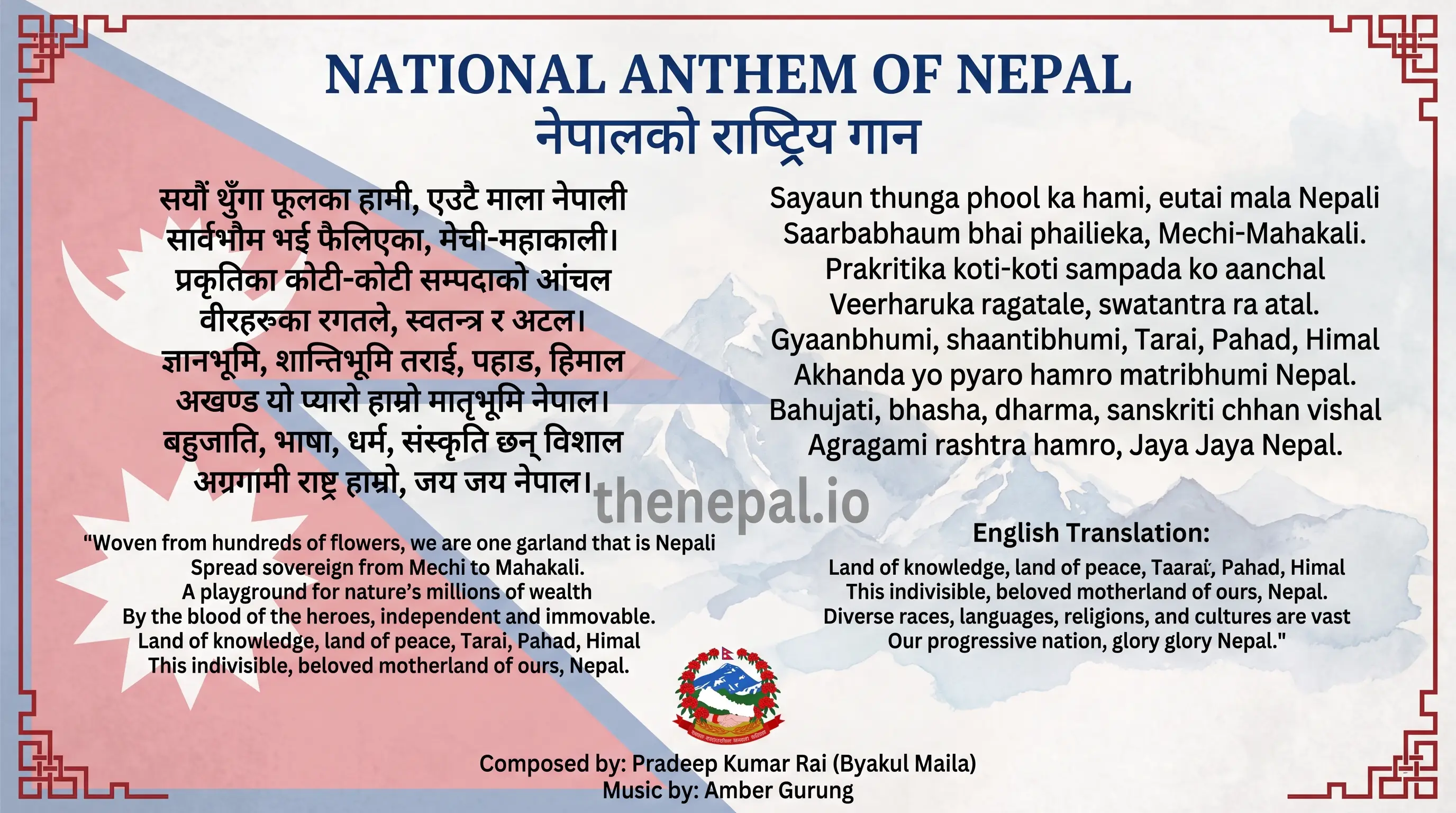
Most national anthems trace back to old monarchies or wars of independence. Nepal's does something different — it was written after a monarchy ended, chosen through open competition, and shaped deliberately to avoid glorifying any single ruler. That origin story is part of why "Sayaun Thunga Phulka" feels less like a proclamation and more like an invitation: hundreds of different flowers, one shared garland.
From Monarchy to Republic: Why the Anthem Changed
Nepal's previous anthem, "Shriman Gambhir," had been in use since 1962 and was built around praising the reigning king. Following the 2006 movement that led to the monarchy's abolition, the interim House of Representatives voted unanimously to discontinue it, judging that an anthem centred on a single royal figure no longer represented the nation as a whole.
In its place, the National Anthem Selection Task Team opened submissions to the public rather than commissioning a single poet. The response was enormous: 1,272 entries were submitted from across the country. Pradeep Kumar Rai, writing under his pen name Byakul Maila, won the selection on 30 November 2006, and Amber Gurung set his words to music. The new anthem received official approval on 20 April 2007 and was formally declared the national anthem on 3 August 2007, in a ceremony at Singha Durbar led by parliamentary speaker Subas Chandra Nemwang.
Source: Nepal Law Commission; Government of Nepal
Two anthems, one century
Who Wrote It
| Role | Name | Notes |
|---|---|---|
| Lyricist | Pradeep Kumar Rai, "Byakul Maila" | Selected from 1,272 public submissions |
| Composer | Amber Gurung (1938–2016) | Prominent Nepali musician; founding chancellor, Nepal Academy of Music and Drama |
Amber Gurung, born in Darjeeling to a Nepali family, composed more than a hundred songs over his career and helped shape Nepal's modern music institutions before writing the anthem's melody in 2007.
Structure at a Glance
Musically, the anthem is notably compact: it spans a single octave from its lowest to its highest note, both landing on D, which makes it comparatively easy to sing across a wide vocal range. In 2016, the BBC ranked it third in a list of the most distinctive national anthems ahead of the Rio Olympics, citing its musical character relative to other countries' anthems.
What the Anthem Is About
Without reproducing its lyrics, the anthem's central image is unity through diversity: many different flowers gathered into a single garland, representing Nepal's many ethnicities, languages, religions and cultures joined as one nation. From there, the verses move through the country's sovereignty stretching between its easternmost and westernmost rivers, its natural wealth, the sacrifice of those who won its freedom, and its mix of plains, hills and Himalaya as one unbroken homeland. The anthem closes on a forward-looking note, framing Nepal as a progressive nation moving ahead together.
✦ Did you know?
- The anthem makes no mention of any king, president, or ruling party — a deliberate choice after 2006.
- It was chosen through open public competition, not commissioned from a single official poet.
- Its composer, Amber Gurung, was born and raised in Darjeeling, India, to a Nepali family.
When and How It's Performed
Nepali law requires citizens to stand and show respect during the anthem, alongside the national flag. It is played at the opening of parliamentary sessions, presidential swearing-in ceremonies, state visits by foreign dignitaries, national holidays, and major sporting events, and radio and television stations broadcast it at the start and close of daily transmission. Many schools and government offices also play it each morning.
Frequently Asked Questions
What is the national anthem of Nepal?
Sayaun Thunga Phulka is the national anthem of Nepal. It was officially adopted on 3 August 2007.
Who wrote and composed Nepal's national anthem?
The lyrics were written by poet Pradeep Kumar Rai, known by his pen name Byakul Maila, and the music was composed by Amber Gurung.
When was Sayaun Thunga Phulka adopted?
It was selected on 30 November 2006 and officially declared Nepal's national anthem on 3 August 2007, replacing the previous anthem Shriman Gambhir.
What was Nepal's national anthem before Sayaun Thunga Phulka?
The previous anthem was Shriman Gambhir, used from 1962 until it was discontinued in 2006 following the movement to end the monarchy.
What is Sayaun Thunga Phulka about?
The anthem celebrates Nepal's sovereignty, unity in diversity, natural beauty, the courage of its people, and its progress as a nation, without reference to any monarch.