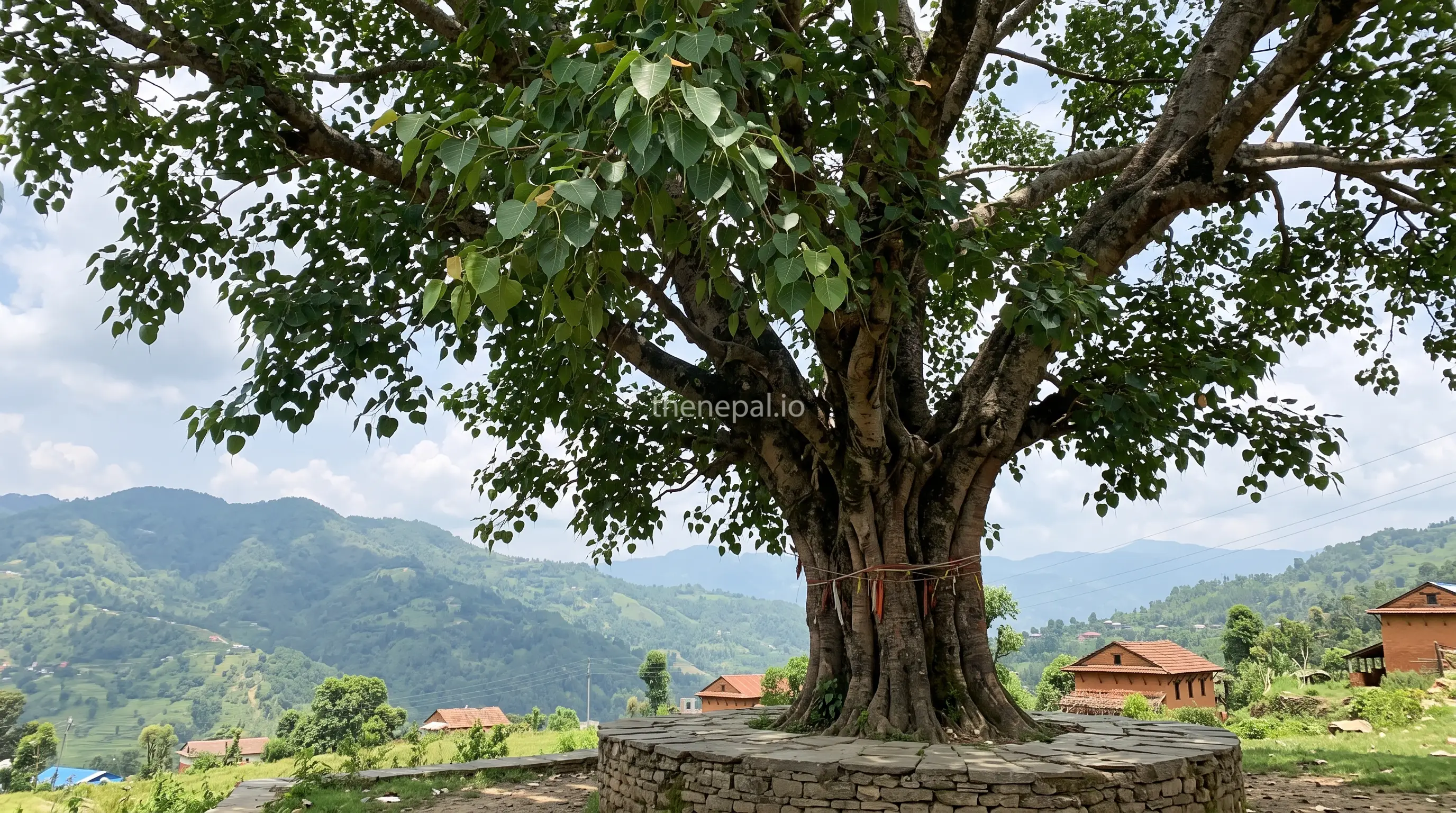
Walk through almost any Nepali village and you'll eventually pass beneath one: a Peepal, its heart-shaped leaves trembling even when the air seems still, its trunk often wrapped in red thread or ringed by a stone platform where people rest, chat and pray. Few trees anywhere carry this much accumulated meaning simply by standing where they've always stood.
Why the Peepal Became Nepal's National Tree
The Peepal is recognised as Nepal's national tree in acknowledgment of its extraordinary religious, cultural and ecological standing — a status shared informally alongside the country's other natural emblems, such as the rhododendron as national flower and the cow as national animal. Unlike symbols chosen for rarity, the Peepal earned its place through sheer constancy: it has shaded temple courtyards, crossroads and village squares across the subcontinent for thousands of years.
Its selection reflects something distinctly Nepali about how the country honours nature — not through a single decree so much as through centuries of lived reverence that made formal recognition feel almost inevitable. The tree's presence threads through daily ritual, architecture and memory in a way few other species can match.
Source: Department of Forests and Soil Conservation, Government of Nepal
Sacred Across Four Religions
Few plants anywhere hold devotional status in more than one tradition. The Peepal is venerated across four major religions that trace their roots to the Indian subcontinent — a rare convergence that helps explain why it was a natural fit as a national symbol in a country where Hinduism and Buddhism have coexisted for centuries.
One tree, four traditions
In Hindu practice, the tree is closely associated with Vishnu, and worshippers commonly perform circumambulation, walking around the trunk while chanting in its honour. In Buddhist tradition, Gautama Buddha is said to have reached enlightenment while meditating beneath a Peepal at Bodh Gaya, which is why the species is also called the Bodhi Tree — from "bodhi," meaning awakening.
Characteristics of the Peepal
Botanically, the Peepal is a fig species with a few unmistakable traits that make it easy to identify even from a distance.
| Feature | Description |
|---|---|
| Leaves | Heart-shaped with a long, tapering drip-tip; flutter easily in light wind |
| Height | Commonly reaches 20–30 m with a broad, spreading canopy |
| Roots | Often begins life as an epiphyte, later sending roots down to the ground |
| Bark | Smooth, grey, thickening with age |
| Lifespan | Exceptionally long-lived; some individual trees are believed to be centuries old |
| Native range | Nepal, India, Bangladesh, Sri Lanka and parts of Southeast Asia |
✦ Did you know?
- A cutting from the original Bodhi Tree was rooted in Sri Lanka over two thousand years ago and is still alive today.
- The Peepal's leaves are said to tremble even without wind, a trait woven into local folklore and myth.
- In India, the Bharat Ratna civilian award is shaped like a Peepal leaf, underlining the tree's subcontinent-wide symbolism.
Culture, Uses and Everyday Life
The village chautari
Across Nepal's hills, Peepal trees are often planted alongside a Banyan on raised stone platforms called chautari, built as resting spots for travellers and porters. These shaded platforms double as informal community gathering points, where conversation, rest and ritual all take place beneath the same canopy.
Traditional and medicinal use
Various parts of the Peepal — its bark, leaves and fruit — have long been used in traditional Ayurvedic remedies across the region. The tree's wood, roots and latex also appear in folk practices, though as with any traditional remedy, these uses should be approached with guidance from someone knowledgeable rather than self-prescribed.
Symbolism
The Peepal represents longevity, wisdom and spiritual awakening in Nepali culture. It appears frequently in religious art, temple architecture and oral storytelling, and cutting one down is traditionally treated with caution or avoided altogether in many communities out of respect for its sacred status.
Where to see it
- Lumbini — the birthplace of the Buddha, home to Peepal trees of deep pilgrimage significance.
- Kathmandu Valley — mature Peepal trees shade temple courtyards throughout Patan, Bhaktapur and Kathmandu.
- Village chautari platforms — found along trekking routes and rural roadsides across the mid-hills.
- Pashupatinath and other temple complexes — Peepal trees are a common feature of Hindu temple grounds.
Conservation Status
Ficus religiosa is widespread and not considered threatened; if anything, it is a hardy, fast-growing species that can establish itself in unlikely places, including cracks in old buildings and walls. Its ecological role is nonetheless significant — its fruit supports birds and other wildlife, and its long lifespan means mature specimens often anchor local ecosystems for generations. Conservation attention in Nepal tends to focus less on the species' survival and more on protecting individual old-growth or sacred trees from urban development and infrastructure projects.
Source: Department of Forests and Soil Conservation, Government of Nepal; IUCN
Frequently Asked Questions
What is the national tree of Nepal?
The Peepal, also called the Sacred Fig or Bodhi Tree and known scientifically as Ficus religiosa, is the national tree of Nepal.
Why is the Peepal Nepal's national tree?
It was recognised for its deep religious significance across Hinduism, Buddhism, Jainism and Sikhism, its extraordinary longevity, and its everyday presence as a shade and gathering tree in villages and temple courtyards across Nepal.
Why is the Peepal tree sacred in Buddhism?
Gautama Buddha is believed to have attained enlightenment while meditating beneath a Peepal tree at Bodh Gaya, which is why it is also called the Bodhi Tree, meaning the tree of awakening.
How long do Peepal trees live?
Peepal trees are exceptionally long-lived, with reported lifespans running into the hundreds and even thousands of years, making them some of the oldest living things people regularly encounter.
Where can I see Peepal trees in Nepal?
Peepal trees are common throughout Nepal's lowlands and mid-hills, especially near temples, monasteries, village squares and roadside rest platforms called chautari, with notable concentrations around Lumbini and the Kathmandu Valley.